

Can You Begin Cosmetology School at 16? High School Training Options Explained
Essential Points Before You Begin
- An Earlier Start May Be Possible: Some states permit beauty training before high school graduation, but eligibility depends on age, educational background, state regulations, and the school's admission policies.
- Funding Varies by Program: CTE and dual-enrollment opportunities may lower education expenses and let students complete approved training hours early. The amount of financial support and the hours accepted toward licensing depend on the specific arrangement.
- Enrollment Is Not the Same as Licensing: Being old enough to attend classes does not necessarily mean you meet the requirements to take licensing examinations or begin working professionally.
- Cosmetology Offers a Broad Foundation: Programs typically combine hair services with introductory skincare, nail care, sanitation, and salon operations. Students drawn primarily to skin or nail services should also investigate specialized training.
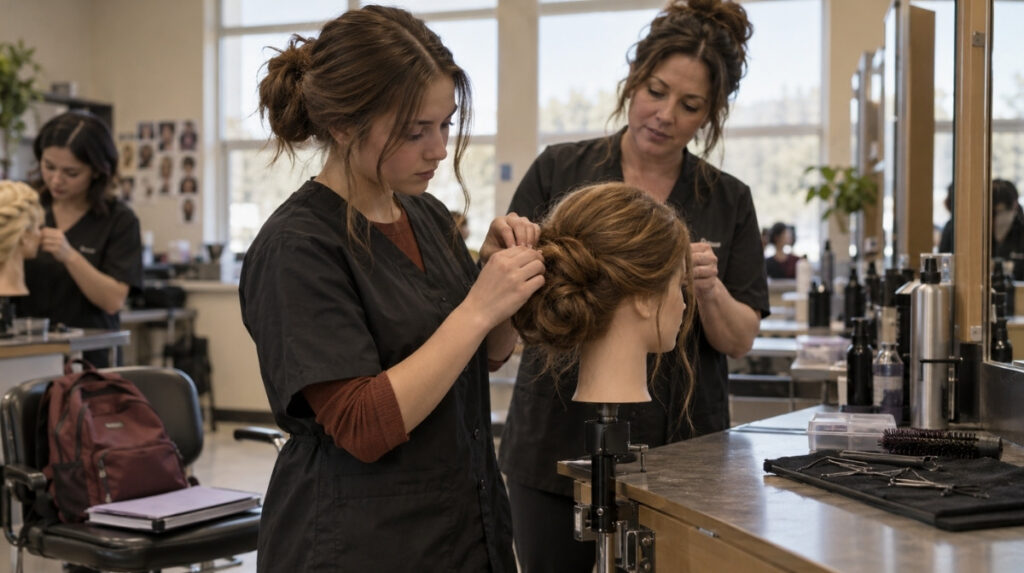
Juggling traditional high school classes can feel frustrating when your mind is set on learning modern hair techniques or understanding skincare products. Fortunately, graduation does not always have to be your starting line. Depending on where you live, early training pathways may allow you to build practical skills, complete recognized hours, and potentially reduce the education costs you face later.
Before choosing a campus, though, look beyond whether it accepts younger applicants. Your training needs to meet the state's requirements, contribute toward your intended license, and fit around the coursework you still need for high school graduation.
Making Sense of Beauty School Entry Requirements
When prospective students ask how old to get into cosmetology school, the answer depends on more than their birthday. There is no nationwide admission standard covering every beauty program. State laws and board regulations establish eligibility for different stages of training and licensing, while schools may apply additional entrance requirements.
Starting classes, registering an apprenticeship, qualifying for examinations, and receiving a professional license are separate steps. Permission to begin at 16, for example, does not necessarily mean you can work as a licensed cosmetologist at that age. You may still need to meet further education requirements and complete the approved training pathway.
Some states accept a 10th-grade education instead of requiring a high school diploma for cosmetology examination or licensing eligibility. The South Carolina Board of Cosmetology, for instance, lists a minimum age of 16, a 10th-grade education or equivalent, and 1,500 hours of approved school training for cosmetology applicants. Similarly, the Alabama Board of Cosmetology and Barbering requires examination candidates to be at least 16 and document completion of the 10th grade or a higher educational level. These are examination or licensing qualifications, not a universal admission policy for every school.
California illustrates another distinction. The California Board of Barbering and Cosmetology generally requires cosmetology examination applicants to be at least 17 and have a 10th-grade education. Its apprenticeship route, however, allows entry at 16 after completing the 10th grade or an equivalent. The opportunity to begin learning therefore comes before examination eligibility.
For help separating school admission policies from licensing requirements, explore what you actually need to enroll in cosmetology school. Resources such as the Natural Healers Cosmetology Licensing Guide can provide a useful introduction, but the relevant state board should be your final reference for current rules.
Arkansas has its own student eligibility standards. Applicants generally must be at least 16 and have completed two years of high school or an equivalent education. Check the latest requirements with the Arkansas Department of Health Cosmetology Section and the school before submitting an application.
Georgia also distinguishes entry into training from qualification for professional practice. Under Georgia Code § 43-10-14, individuals who are at least 16 may learn cosmetology in a school under a qualified instructor or through a registered apprenticeship. For the initial master cosmetologist licensing pathway, Georgia Code § 43-10-9 generally requires applicants to be at least 17, hold a high school diploma, state-approved high school equivalency diploma, or postsecondary degree, complete the qualifying school or apprenticeship training, and pass written and practical examinations. A school's admission policy may be stricter than the state's minimum training age.
What Applicants Younger Than 18 Should Expect

Attending cosmetology school under 18 is possible in some locations, but both the law and the school's policies matter. Schools commonly ask a parent or legal guardian to sign enrollment contracts, financial arrangements, or consent documents for minors. The required paperwork is not identical everywhere.
Depending on the program, you may need identification, proof of age, and an official transcript confirming the education you have completed. A campus may also require a diploma or recognized equivalent even when state rules allow younger students to begin training.
Completing approved hours while you are a minor does not remove the remaining licensing requirements. You may still need to finish your education, reach the required age, and pass the applicable examinations. Exam formats vary as well. California eliminated its practical licensing examination requirement on January 1, 2022, as explained in the California Board's examination guidance.
Knowing which requirements apply at each stage helps you plan for any gap between finishing training and becoming eligible to practice.
Finding a Training Route That Fits Around High School
If you are searching for a high school with cosmetology classes, several arrangements may be available. Possibilities include district-operated vocational courses, regional Career and Technical Education centers, concurrent enrollment at a technical college, private state-approved beauty schools, and registered salon apprenticeships in states that authorize them.
Some school districts work with technical centers or colleges so students can divide their time between academic subjects and vocational instruction. Depending on the partnership, a student might attend regular high school classes for part of the day and spend the remaining hours in a supervised beauty lab.
The amount of training available through these arrangements can differ substantially. The Technical College of the Rockies High School Cosmetology Program provides one concrete example. Its half-day concurrent-enrollment course spans four semesters over two school years and lists 1,211 training hours. The published combined cost for 2026–2027 is $10,255.99, showing that a high school concurrent-enrollment program is not necessarily free.
That price also highlights why funding deserves a separate conversation. Depending on the partnership, tuition may be subsidized through CTE or dual-enrollment funding, while students remain responsible for other expenses. In other programs, families may need to cover tuition as well as kits, books, uniforms, transportation, registration, and examination fees. Request an itemized explanation of the charges and who pays each one.
A private beauty academy may be another possibility if its admissions rules and available schedule fit your situation. Do not assume every school offers evening, weekend, part-time, or year-round classes. Ask which options are currently available and whether students still attending high school are eligible.
An approved vocational route may allow you to finish high school with part of your professional training already completed. To estimate what might remain afterward, review cosmetology training hours and the differences between full-time and part-time study. Your weekly attendance, required hours, and school calendar will all influence the timeline.
Before accepting a place, get clear answers to these questions:
- Does this school and program meet the state's approval requirements for the license I want?
- How will my completed hours be recorded and reported?
- How much recognized training can I finish before leaving high school?
- Which expenses are covered, and which will my family need to pay?
- What happens to my hours if I change schools or move out of state?
- Can I attend without missing courses required for high school graduation?
- Will I need additional cosmetology classes after earning my diploma?
Looking Beyond Haircuts When Choosing Your Program
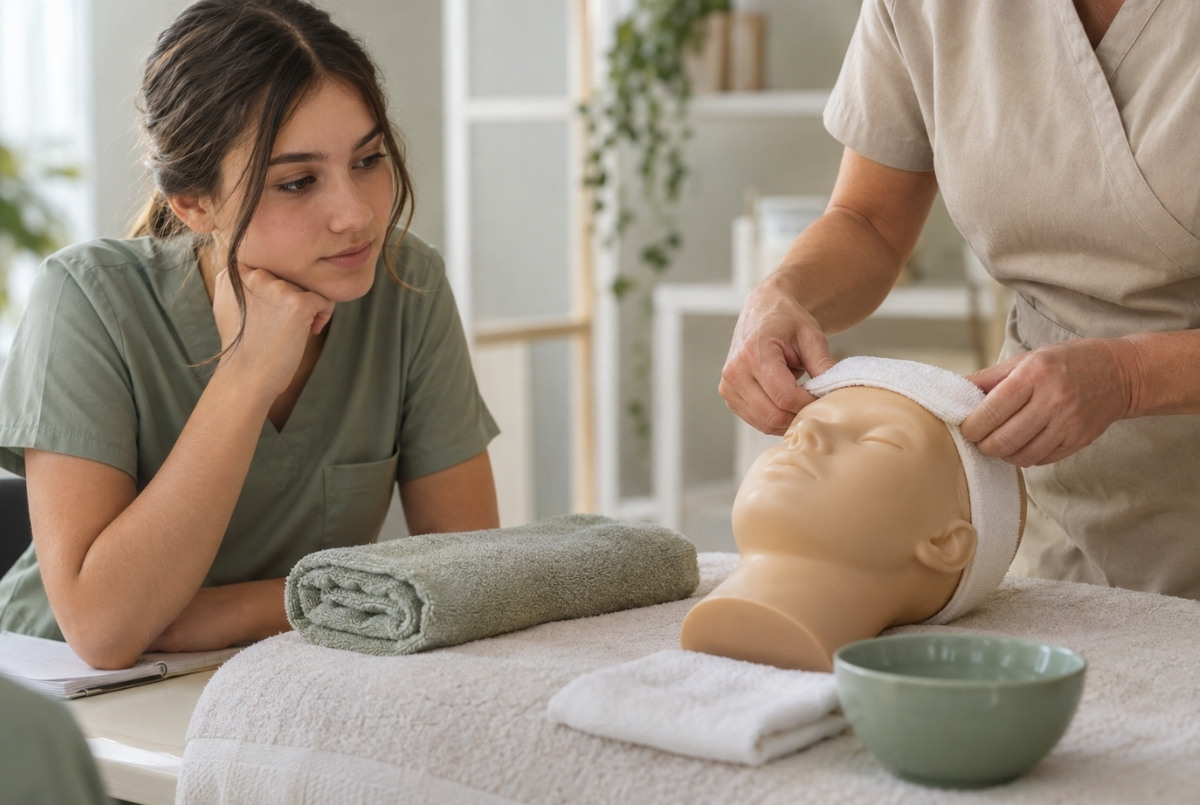
A cosmetology education reaches beyond haircuts and basic color services. Students generally study styling, chemical processes, hygiene, client protection, and salon operations, along with introductory skin and nail services. The balance between these subjects depends on state curriculum requirements and the individual program.
Georgia provides a useful example of how instruction progresses. The Georgia State Board's cosmetology curriculum rules establish a 1,500-hour master cosmetology program. Students must complete 250 hours of Level 1 training before advancing to Level 2 clinical services on patrons. This opening stage combines theory and mannequin practice with foundational instruction that includes skin and nail care.
If facials, skin analysis, waxing, makeup, or spa services interest you more than hair, compare cosmetology with an esthetician program. Georgia's separate 1,000-hour esthetician curriculum concentrates on subjects such as skin sciences, facial services, hair removal, makeup, client documentation, and salon or spa management.
Students primarily interested in nails can make a similar comparison. A dedicated nail technology course focuses its training on nail services, product use, sanitation, and application techniques. Check the actual curriculum to see which services and nail enhancement methods it covers.
Specialized instruction should not be confused with legal permission to offer every treatment. A course completion certificate alone does not authorize medical procedures. Certain exfoliation techniques, devices, laser services, injections, or other treatments may require a different professional license, legally permitted delegation, or medical supervision. Whether a service is allowed depends on the procedure and the laws in the state where it is performed.
Beauty education may also introduce the practical side of working with clients: scheduling appointments, recommending retail products, keeping records, marketing services, and managing salon responsibilities. These skills can support entry-level employment and provide a foundation for later self-employment. Salon or suite ownership involves additional planning, however. Depending on the location and business arrangement, establishment licensing, business registration, permits, and insurance may be necessary. Prior professional experience can be valuable, but it is not a universal legal condition for opening a beauty business.
The employment outlook helps explain interest in skincare careers. The U.S. Bureau of Labor Statistics report on skincare specialists projects 9% employment growth between 2025 and 2035, versus 3% across all occupations. It also estimates an average of approximately 14,200 openings annually during that period. Those openings include positions vacated by people changing occupations or leaving the workforce; they do not represent 14,200 additional jobs created each year.
Independent work is also a notable part of the wider industry. A 2022 policy submission from the American Association of Cosmetology Schools reported, using 2020 data, that 33% of workers in personal appearance occupations were self-employed, compared with 6% of the overall workforce. This is historical evidence that self-employment is common in the field, not a prediction of what a teenager or newly licensed graduate will earn or how soon they can run a successful business.
Building Your Plan Before Graduation

Once you have an idea of the training you want, a few practical checks can help you turn that interest into a workable plan.
Start with your state cosmetology board. Look up the rules for entering school, becoming an apprentice, qualifying for examinations, and applying for a license. Write down the requirements separately so you do not mistake permission to begin training for permission to work professionally.
If moving is a possibility, consult a state-by-state overview of cosmetology hours, examinations, and renewals. Ask specifically about unfinished training if you might relocate before graduation. Evaluation of student hours is different from endorsement or reciprocity for someone who already holds a license.
Your high school counselor should be part of the next conversation. Ask about district CTE programs, regional technical centers, and nearby college partnerships. Confirm whether the classes would count toward electives, vocational requirements, or other graduation credits at your school.
Then contact potential beauty schools. Explain that you are still in high school and ask about admission eligibility and current attendance options. Daytime, evening, weekend, and part-time schedules are possibilities at some institutions, but none should be assumed without confirmation.
After selecting a suitable route, collect the documents on the school's admissions checklist. These may include transcripts, identification, proof of age, and parent or guardian signatures where required.
Finally, verify that the program meets the state's requirements for recognized licensing education. Institutional accreditation serves a different purpose, involving educational quality oversight and potentially affecting eligibility for federal student aid. It is neither a substitute for the relevant state approval nor a promise that another state will accept your hours.
Questions Students and Families Often Ask
Could I lose training hours by relocating before completing the program?
Some hours may be accepted, but transfer is not automatic. The receiving board or school may evaluate your subjects, documented hours, and previous program against its own standards. You may need an official transcript and additional training. Ask about partial education transfers before moving, rather than relying on rules intended for licensed professionals.
Is federal student aid available while I am still attending high school?
Students enrolled in high school generally are not eligible for federal Title IV aid, including Pell Grants, for concurrent cosmetology study. Being younger than 18 is not the deciding factor by itself; continued high school enrollment matters. District support, state or local dual-enrollment funding, school scholarships, or private assistance may offer other options. Request an explanation of your eligibility and remaining expenses before committing.
Can I keep a four-year college option open while studying cosmetology?
Yes, provided you complete the academic requirements of your high school and the colleges you may apply to. Beauty or vocational classes may count as elective or career-education credits, depending on local policies. College-level cosmetology coursework might transfer as electives, qualify under a specific agreement, or receive no credit toward your intended degree. Check with your counselor and the receiving college rather than assuming it will transfer.
Does reaching 18 automatically make me eligible for a license?
No. You still need to satisfy the applicable education, training, examination, and application requirements. Turning 18 may change whether a parent or guardian must sign school documents, but contract rules and school procedures vary. Ask admissions which paperwork needs updating when you reach adulthood.
What should I compare before deciding an early training program is worthwhile?
Look at the recognized hours you can earn, the full cost after any funding, the weekly schedule, and the training you will still need after high school. Also consider whether the program leaves room for your graduation requirements. Lower tuition has limited value if the hours do not qualify for your intended licensing pathway or must later be repeated.
Explore Your Next Step With Hogan Institute
An early interest in beauty can become a practical career plan when you understand your options and choose training that fits your eligibility, goals, and schedule.
At Hogan Institute of Cosmetology & Esthetics in Lilburn, Georgia, students can explore professional cosmetology and esthetician training. The school's published programs emphasize hands-on learning, client relations, and business skills alongside technical instruction.
Visit our enrollment page or use the website's contact form to speak with the team about current admission requirements and schedules. If you are still attending high school, ask whether your circumstances meet the school's current policies and what steps you can take next.