

Choosing a Master Cosmetology School in Georgia: What Matters Beyond Tuition

A tuition quote tells you little about the guidance you will receive, the client experience you will gain, or whether you can manage the schedule. Choosing a master cosmetology school in Georgia means looking at how training, attendance, and complete costs fit your life. Here is how to compare those details before committing.
Key Takeaways
- Compare instructor feedback, practical training, schedules, and complete costs alongside tuition.
- Georgia’s school-based master cosmetology pathway requires 1,500 hours across several types of instruction.
- A student salon’s menu does not establish how much individual practice or guidance students receive.
- Request current, itemized charges and understand the attendance assumptions behind completion estimates.
- Evaluate examination preparation and career support separately from promises about employment or earnings.
What Should You Look for Beyond Cosmetology School Tuition?
Start with three questions: Can you attend consistently? How will the school help you improve? What will completing the program cost?
These questions connect factors that are often considered separately. A manageable tuition payment cannot solve an impossible commute. A busy student salon does not explain how instructors address gaps in your technique. An appealing completion estimate needs a realistic attendance plan behind it.
Ask a school representative to describe how students progress from their first classes through graduation. Listen for explanations of practical assignments, assessments, instructor feedback, and preparation for licensing. You should leave understanding how learning is organized, rather than simply knowing which subjects appear in a brochure.
Then make the conversation personal. If chemical services worry you, ask how instructors support students learning those procedures. If skincare interests you more than hair services, explore what becoming an esthetician involves, from education costs to career options, before deciding which program fits your goals. Choosing the appropriate field comes before choosing a school.
Understand What Georgia’s Master Cosmetology Training Requires
According to Georgia’s cosmetology curriculum rules, the school-based pathway requires 1,500 training hours over a minimum of nine months. These are clock hours—measured training time—rather than college semester credits. A program’s calendar length also depends on its weekly schedule, school calendar, and your attendance.
Students must complete 250 hours of Level 1 training before performing clinical services on clients or patrons. Advancement to Level 2 also requires a minimum passing score of 75%. The next stage includes further theory, practical training, and service application.
Ask what happens when you need additional instruction before progressing. Will an instructor demonstrate the technique again, observe another attempt, or assign focused practice? Understanding that process helps you evaluate how the school responds when a student needs more support.
The 1,500-hour requirement does not mean students spend all that time serving clients. Georgia’s curriculum combines different learning activities, so ask how classroom instruction, demonstrations, mannequin practice, and client services build on one another.
Look Closely at Hands-On Training and the Student Salon
Ask How Practice Turns Into Useful Feedback
“Hands-on training” describes an activity. To evaluate its educational value, find out how instructors help you understand the result.
Imagine completing a haircut with uneven layers. Useful feedback would identify whether the problem began with sectioning, tension, or elevation—the angle at which you held the hair. Understanding the cause gives you a specific correction to practice.
Ask how instructors record progress and revisit techniques that need improvement. Also ask how the school addresses uneven experience. A student who needs more practice with color application may need different assignments from someone struggling with haircutting.
Include consultation in this conversation. Ask whether students practice confirming the intended length, discussing maintenance, and explaining realistic results before beginning a service. These exercises connect technical decisions with the person receiving the service.
Evaluate the Student Salon Beyond Its Appearance
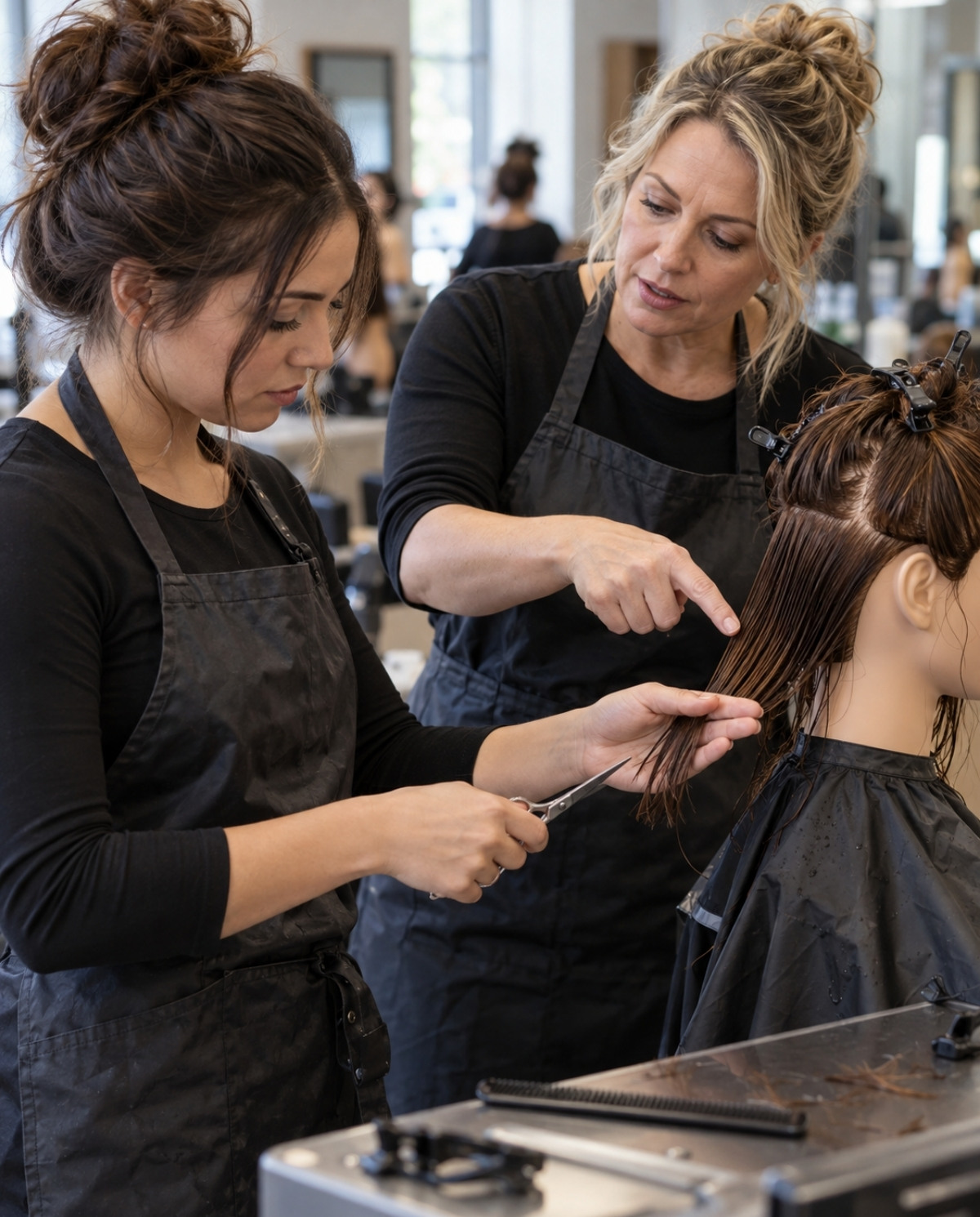
When visiting a student salon, look beyond the equipment and décor. Ask how appointments are assigned, when instructors check students’ work, and how practical assignments are evaluated.
Client requests may not arrive in the same proportions as curriculum requirements. Ask how the school arranges practice when a particular service is requested less frequently. You want to understand how students work through their training rather than assuming a busy appointment book answers that question.
If you are also considering a dedicated skincare program, compare the practical learning environment rather than assuming it mirrors a cosmetology salon. Our guide to what esthetician school is like offers a closer look at that training experience, helping you prepare more specific questions for a visit.
If observation is available, notice the teaching interactions. Does an instructor explain a correction? Can the student apply it and receive another assessment? Those exchanges help you evaluate the learning process.
Hogan’s salon menu includes cornrows, loc services, roller sets, rod sets, and finger waves. These offerings give you specific techniques to discuss during a visit. Ask how related practice and assessment are organized, since a service menu alone does not establish how often each student performs them.
Notable Georgia Cosmetology Schools and Their Standout Features
Beaver Beauty Academy, Hogan Institute, Georgia Career Institute, and Health and Style Institute illustrate different educational features worth examining. This shortlist draws on published materials, including historical program descriptions, rather than a scored ranking or confirmation of enrollment availability.
Beaver Beauty Academy — Day and Evening Scheduling
Beaver Beauty Academy’s published admissions information describes a 1,500-hour Master Cosmetologist program with day and evening arrangements. Its evening schedule includes Saturday attendance, an important detail for someone hoping to preserve weekday working hours.
The school also publishes estimated completion periods and contract overage rates. These details allow students to examine how attendance and enrollment terms interact, rather than comparing tuition without considering what happens if training takes longer than expected.
Hogan Institute of Cosmetology and Esthetics — Schedule Variety and a Lilburn Location
Hogan’s published information provides several concrete points for students comparing cosmetology schools in Lilburn and the surrounding Atlanta area. Its 1,500-hour Master Cosmetologist program is accompanied by full-time, three-day, part-time morning, and part-time evening schedule options. Its financial information also separates tuition from registration, learning materials, uniforms, and kit charges.
That combination gives you a practical starting point: discuss an attendance arrangement, then request the financial terms that apply to your intended start date. Review current enrollment documents rather than relying on an older downloadable fee sheet.
The salon services described earlier provide another point of discussion, particularly if you want to explore different styling and textured-hair techniques. During a campus visit, connect those offerings with questions about assignments, instructor feedback, and additional practice.
For someone whose commute centers on Lilburn or nearby communities, Hogan brings location, schedule choices, and published program details into the same conversation. Your decision can then focus on the training arrangement and financial commitment that apply to you.
Georgia Career Institute — Digital Resources and Client-Building Practice
Georgia Career Institute’s published cosmetology materials describe Pivot Point’s LAB platform for theory assignments, program tasks, and assessments. The listed kit includes digital resources, electrical tools, practice mannequins, and supplies for several service areas. These details identify the learning resources described for the program more clearly than a general reference to modern technology.
The same materials describe a senior phase involving client services and opportunities to begin developing a client book. A client book refers to the relationships and service information supporting repeat appointments. That emphasis connects technical practice with maintaining professional client relationships.
Health and Style Institute — A Broader Salon Leadership Focus
Health and Style Institute’s published program descriptions described a Salon and Spa Leadership program combining preparation for master cosmetology licensure with additional skincare, makeup, and business education. That broader leadership emphasis was a distinguishing feature of its educational approach.
For someone interested in eventual management or ownership, this provides a useful comparison point: how much attention does a program give to the responsibilities surrounding a service business? Leadership coursework should still be evaluated separately from claims about employment, management readiness, or earnings.
Choose a Schedule and Commute You Can Sustain
For students comparing cosmetology schools near Atlanta, the practical commute is the journey at class time. Test the route when you would normally arrive and leave, including parking, transportation connections, and childcare arrangements where relevant.
Review instructional hours separately from campus business hours and salon service hours. Ask how breaks, holidays, absences, and makeup opportunities affect your progress.
Consider the tradeoff between weekly intensity and calendar length. Fewer instructional hours per week spread the required training over a longer period. A concentrated schedule may require larger changes to your working week.
Hogan’s published schedule choices give you several arrangements to discuss. Confirm which applies to your program and anticipated start date, and ask how a later schedule change would affect your completion plan.
Calculate the Full Cost Before Comparing Prices

Separate Tuition From Other School Charges
Request an itemized breakdown of tuition, registration, books, digital resources, uniforms, equipment, and required supplies. Ask whether examination and licensing expenses are included or paid separately.
For the kit, request an inventory. Clarify ownership, replacement responsibilities, and how consumable supplies are handled. “Kit included” becomes useful information only when you understand what is supplied and what you may need later.
Read withdrawal and refund terms before signing. The Federal Student Aid Handbook’s consumer-information guidance identifies charges, required materials, and withdrawal and refund policies among the disclosures participating institutions must provide.
Georgia’s equipment rules specify basic cosmetology kit contents, but they do not establish whether a school bundles those items into tuition. Confirm the equipment inventory and written charges separately.
Add the Expenses of Attending
Your personal budget should also account for transportation, childcare where applicable, and living expenses during training.
The federal financial-aid term cost of attendance describes an estimated educational budget that can include expenses beyond the school’s bill. Inclusion in that budget does not mean an expense will be fully funded.
Separate grants and scholarships from loans when reviewing funding. Ask what you would pay during training and what borrowing would need to be repaid afterward. This gives you a clearer picture than a monthly payment figure alone.
Ask What Happens Between Graduation and Your First Job
Completing school, passing examinations, and receiving a license are separate milestones. Georgia’s licensing guide lists passed written and practical examinations among the application requirements. Passing those examinations does not, by itself, mean your license has been issued; confirm that your license is active before beginning work as a licensed professional.
Ask what state board preparation includes. Look for explanations of practice assessments, help identifying weak areas, examination procedures, and document preparation. Find out whom you can contact if you need another attempt.
Evaluate career support just as specifically. If résumé assistance, interview preparation, or employer introductions are offered, ask how students access them. Each service is different from a guaranteed job.
Graduation, examination passage, and placement rates measure different results. The Federal Student Aid Handbook explains a federal graduation-rate framework focused on first-time, full-time students seeking a certificate or degree. Ask which students and reporting periods each percentage covers before comparing schools.
According to the Bureau of Labor Statistics, the occupation includes substantial self-employment, but its occupational wage figures exclude self-employed workers. Those wages cannot predict salon-owner income or an individual graduate’s earnings. If independent work interests you, ask about client retention, appointment management, and business responsibilities alongside technical instruction.
Bring These Questions to a Hogan Campus Visit
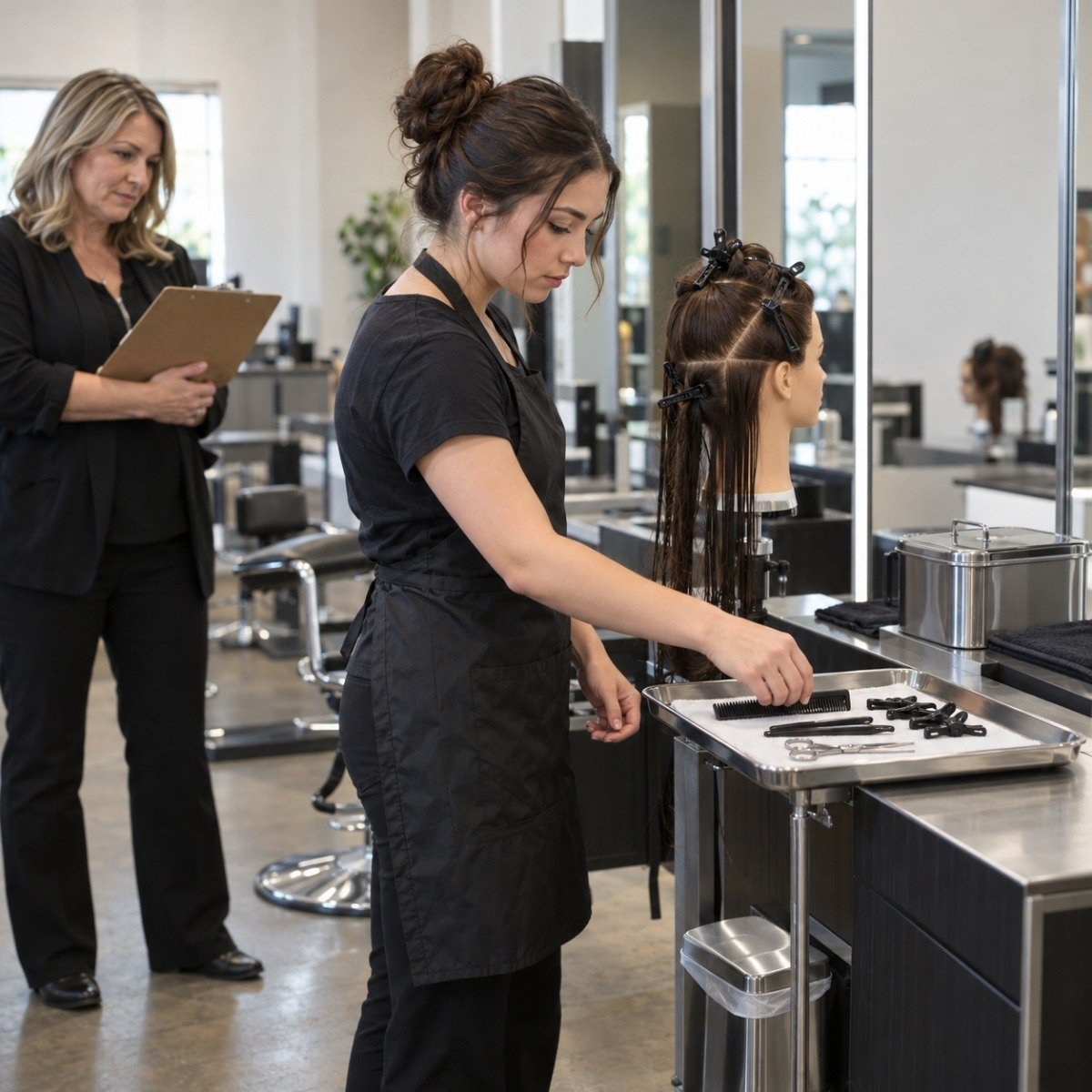
Bring your working hours, transportation arrangements, budget, and career interests into the conversation. Those details help turn general program information into a plan you can evaluate.
Ask how your weekly schedule would work, how readiness for client services is assessed, and what happens when you need additional practice. Request current written charges and discuss examination and licensing support.
You should leave understanding what the program requires, how your progress will be assessed, and whether the commitment fits your life. If something remains unclear, request clarification before signing an agreement.
Frequently Asked Questions
Do I Need Hair or Makeup Experience Before Applying to Cosmetology School?
Prior salon experience is not listed in Hogan’s published admission requirements. Those requirements address age, identification, and educational documentation. Ask admissions to confirm what applies to your circumstances.
Can I Visit a Cosmetology School Before Submitting an Application?
Visit arrangements vary. Hogan offers a no-obligation campus tour where prospective students can explore training spaces and discuss programs, schedules, and financial aid. Bring questions you want answered before applying.
Can Previous Cosmetology Training Count Toward a New Program?
Request a written evaluation before assuming previous hours will transfer. Confirm the receiving school’s acceptance policy, remaining training, resulting charges, and any applicable Board requirements. Federal disclosure guidance requires participating institutions to make their transfer-credit policies available.
Can a Georgia Cosmetology License Be Used in Another State?
The destination state determines eligibility through its licensing process. As the Bureau of Labor Statistics explains, requirements vary by state. Contact that state’s licensing authority before planning to practice there; holding a Georgia license does not automatically authorize work nationwide.
What Is the Difference Between Master Cosmetology and Hair Design?
Georgia establishes separate curricula: master cosmetology includes hair, skin, and nail training, while hair design follows a more hair-focused curriculum. The school pathways require 1,500 hours for master cosmetology and 1,350 hours for hair design. If your main goal is skincare, review the training and examination steps for an esthetician license as a separate educational pathway. Match your intended services to the appropriate license before comparing schools.
Ready to Master Your Craft?
Your future in beauty starts with skills you can build on. At Hogan Institute, our Salon Ready approach connects hands-on training with client service and professional habits to help you prepare for opportunities in beauty and work toward your long-term goals.
Come see our experience in action. Explore our Lilburn campus, meet our team, and discover the training environment behind your next step.
Complete the contact form below to discuss your goals, explore schedules, and become part of Hogan’s continuing story of beauty education.