


Key Takeaways
- Choose a program that matches the services you want to perform.
- Check state approval, accreditation, and financial aid eligibility separately.
- Compare total costs and a schedule you can maintain.
- Request an individual review before assuming previous training hours or a license will transfer.
Choosing a beauty school means finding training that fits your career goals, budget, and daily responsibilities. Whether you are exploring beauty training for the first time or reconsidering your original school choice, compare programs, credentials, schedules, total costs, and student support. Use this guide to evaluate your options and explore whether Hogan Institute of Cosmetology and Esthetics in Lilburn fits your next step.
Start With the Beauty Career You Want
When deciding between cosmetology and esthetician school, think about an ordinary workday rather than a career highlight reel. Would you enjoy consultations followed by cutting, coloring, and styling hair? Or would you prefer evaluating a client’s skincare needs and performing services such as facials and waxing? If you are still deciding whether this career fits you, our guide to the work, income considerations, and training behind a cosmetology career helps you look beyond the services you enjoy and consider the responsibilities of professional beauty work.
Cosmetology offers a broader training direction. Hogan’s Master Cosmetology program describes instruction in hair, skin, and nail services, along with client service and salon business. The BLS description of skincare specialists identifies work such as facials, hair removal, skincare advice, and client consultation—a more focused direction if skincare is your main interest.
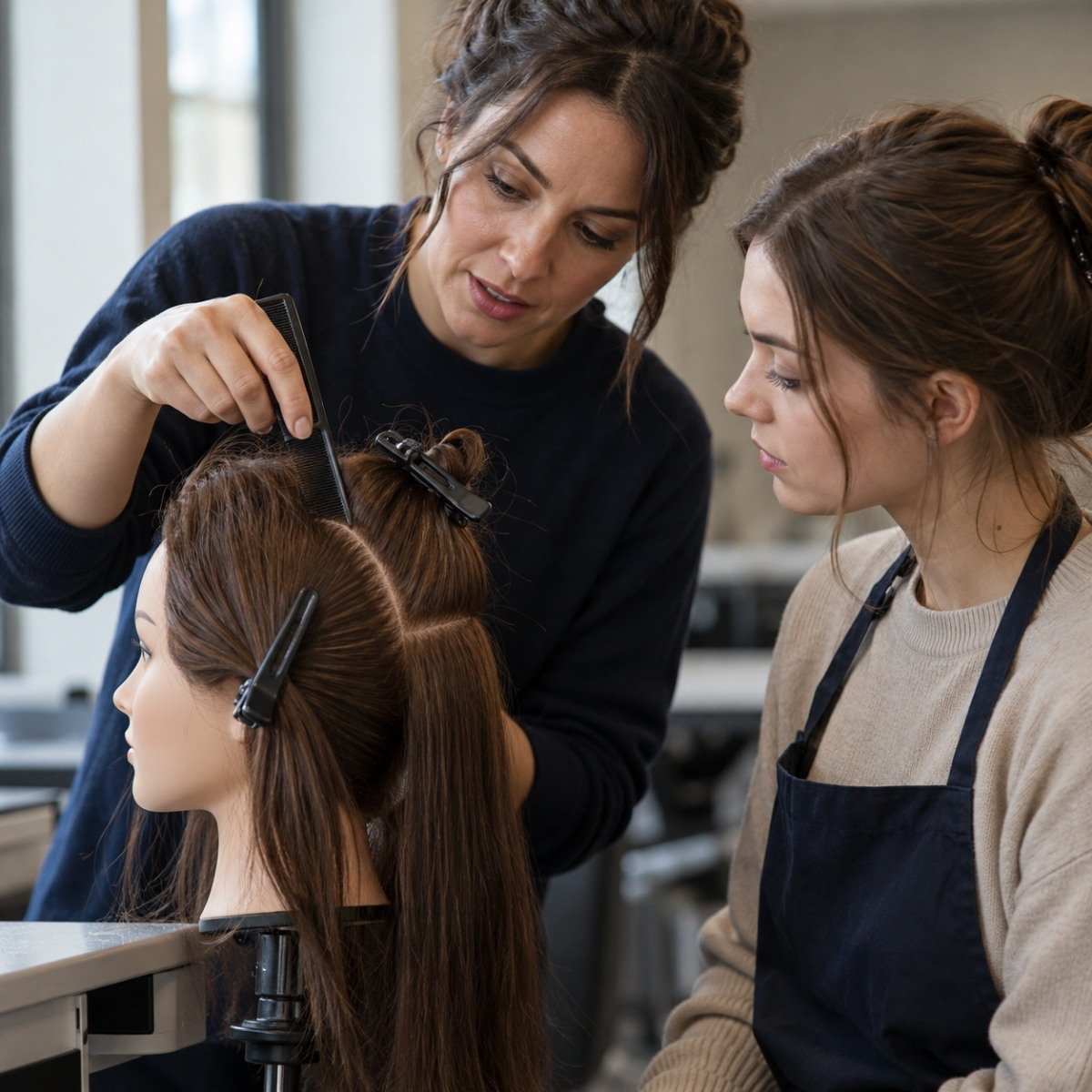
Ask how practice is organized, not simply whether a technique appears on the curriculum. Watching a demonstration, practicing on a mannequin, and performing a service under supervision provide different learning experiences. Find out how students move between those stages and receive corrections.
You should also understand your scope of practice: the services your license legally permits you to perform. A national career description may mention treatments that require different credentials or conditions in Georgia. Ask how your intended program connects to the Georgia cosmetology licensure pathway—the training, examination, and application steps toward becoming licensed.
Career demand provides context, but it should not choose the program for you. According to the U.S. Bureau of Labor Statistics, skincare specialist employment is projected to grow 9% from 2025 to 2035. The agency’s approximately 14,200 annual openings include replacement hiring; net employment growth is approximately 9,100 jobs across the entire decade. Those are national projections, not promises of local jobs or individual outcomes.
Check State Approval, Accreditation, and Financial Aid Participation Separately
If you are looking for accredited beauty schools in Georgia, separate three questions that often get blended together: Can the school legally operate? Who reviews its educational standards? Can eligible students receive federal aid there?
Georgia’s school requirements require a license to operate a cosmetology or related beauty school. Accreditation involves review by an accrediting organization. The Federal Student Aid Handbook explains that participation in Title IV—the federal student aid system—requires Department of Education approval and additional eligibility requirements. These checks serve different purposes.
When comparing state-approved beauty schools in Georgia, request the current school license. Then ask for the accreditor’s name and verification information. Finally, confirm whether your intended program qualifies for the funding being discussed.
Hogan’s published financial aid information describes the institution as accredited and lists federal aid participation. Ask admissions to walk you through current documentation and explain what applies to your program. A written record is more useful than trying to remember everything discussed during a tour.
The same federal guidance makes an important distinction: institutional eligibility and approval to participate in aid programs are separate steps. An accreditation badge alone does not answer every financial aid question. That is why we should verify the school, the program, and your individual eligibility rather than assuming one credential covers all three.
Georgia and Arkansas: Match Your Training to Where You Plan to Work

Georgia’s cosmetology curriculum rule specifies at least 1,500 training hours over a minimum nine-month course. Its esthetics curriculum rule specifies at least 1,000 hours over a minimum nine-month course. These are curriculum minimums, not a promise that every student will finish in nine months.
Georgia also requires 250 hours of initial theory training before students advance to client services, with the progression requirements stated in each program’s rule. When we assess hands-on training, the useful question is how the school prepares students for that transition—not how quickly a beginner can start working on clients.
If you are considering Arkansas training or expect to move between Arkansas and Georgia, check the destination state’s requirements before committing. The Arkansas Department of Health’s cosmetology law describes an application process for professionals licensed in another state. Georgia likewise has licensing-by-endorsement rules. Endorsement or reciprocity means a route to apply using an existing license; it does not make a license automatically valid across state lines.
Transferring while still a student is a separate question from applying for a second state license after graduation. Ask the receiving school about accepted training hours and the destination licensing authority about professional eligibility. For Hogan’s Lilburn programs, Georgia’s requirements are the immediate reference point.
Choose a Location and Schedule You Can Attend Consistently
For students researching beauty schools near Atlanta, distance on a map can be misleading. Test the journey at your proposed arrival and departure times. A manageable midday drive may become a difficult commute when it overlaps with work or school traffic.
Hogan’s contact information lists its campus at 495 Indian Trail Lilburn Road NW, Lilburn, Georgia 30047. If you are comparing schools in Lilburn, calculate the trip from both home and work, and consider what happens when your usual transportation is unavailable.
If evening classes are essential, ask for the actual student timetable. Confirm the days, weekly training hours, scheduled breaks, and expected completion date. Published salon hours or office hours do not establish when students attend classes. Our explanation of how full-time and part-time attendance affect your training timeline shows how to estimate instructional weeks and account for breaks and missed hours before choosing a schedule.
Then discuss missed hours. Ask how makeup training is scheduled, whether it fits around work, and what happens if attendance problems continue. A useful attendance plan includes a backup for predictable disruptions, such as childcare changes, rather than relying on everything going perfectly.
Compare the Complete Cost, Not Just Tuition
When comparing beauty school tuition and fees, request a breakdown that distinguishes required charges, optional purchases, and costs paid to outside organizations. This helps you see both the overall expense and when money will be needed.
Ask whether tuition includes your kit, books, and initial supplies. Find out whether you must replace consumables during training, pay examination or licensing expenses separately, or cover additional charges if completion takes longer than expected. These are questions to investigate, not assumptions that every school imposes the same fees.
Your personal budget also matters. Transportation and childcare can make two similar tuition figures very different in practice. Compare costs over the expected program length, then ask how an extended completion timeline could affect them.
For schools offering financial aid, request an explanation that separates grants, loans, and payment arrangements. Federal Student Aid explains that grants generally do not require repayment, although certain circumstances can create repayment obligations. Loans carry repayment terms. A payment arrangement changes when you pay; it does not automatically reduce the amount owed. To explore how different funding sources might fit together, read our guide to FAFSA, grants, and other ways to pay for cosmetology school, including questions to ask before using a 529 education savings plan.
Hogan’s published financial aid information lists Pell Grants and several federal loan options for eligible students, along with payment arrangements and discussion of loan repayment. Ask for an individualized explanation of anticipated aid and the remaining balance you would be responsible for.
The Federal Student Aid Handbook’s payment-period guidance explains another detail many students miss. Clock hours measure training time, and later federal aid payments depend on successfully completing both required hours and instructional weeks in the preceding payment period. Repeated coursework can delay a disbursement. Ask how the school explains these milestones and communicates changes to your payment schedule.
Look for Student Support You Can Describe in Specific Terms

A school’s support becomes easier to evaluate when you ask about a specific problem. Instead of “Are your instructors helpful?” try: “If I keep struggling with a color formulation, how do I receive feedback and additional practice?”
The answer should tell you who helps, how progress is checked, and what happens next. Ask similar questions about theory lessons, practical assessments, attendance concerns, and licensing preparation. You are looking for a process you can understand.
Hogan’s Master Cosmetology page lists hands-on experiences, salon business, client retention, résumé writing, and job-seeking skills. Ask how these topics appear in assignments and practical work. Client retention, for example, becomes more useful when students practice consultations, explain home care, and respond professionally to concerns.
Business preparation deserves attention: BLS reports that approximately 48% of hairdressers, hairstylists, and cosmetologists were self-employed in 2025. However, BLS wage estimates exclude self-employed workers, so those figures cannot establish typical salon-owner earnings. Ask about preparation for managing appointments, communicating prices, and maintaining client relationships without treating entrepreneurship as guaranteed income.
If you began by searching for the best beauty schools in Georgia, turn that broad question into something testable: Which school offers the training and support that address your needs? When a school shares graduation, licensing, or employment outcomes, ask for the reporting period, who is counted, and how the result was calculated.
What to Look for When Comparing Beauty School Alternatives
If you started your research with Beaver Beauty Academy, Georgia Career Institute (GCI), or Health and Style Institute, you may already have a particular program or training experience in mind. When exploring alternatives, compare what you would actually learn, how you would practice, and whether the attendance commitment fits your responsibilities.
At Hogan Institute of Cosmetology and Esthetics, the published Master Cosmetology program combines hair, skin, and nail instruction with salon business, client retention, résumé writing, and job-seeking skills. That combination gives you specific things to evaluate: preparation for performing services, communicating with clients, and pursuing work after licensure.
During a campus visit, ask to see how those skills are taught. Discuss supervised practice, instructor feedback, and your proposed schedule so you can connect the program description to the experience you would have as a student.
Frequently Asked Questions
Can I tour a beauty school before applying?
Hogan’s tour information offers a free, 30-minute, no-obligation campus visit. Arrange it ahead of time and mention the program you want to explore. Ask whether your appointment can include discussion of training, scheduling, and financial planning.
Do I need previous beauty experience to enroll?
Hogan’s cosmetology page describes training that guides beginners toward professional preparation. Previous experience is separate from admission eligibility, so ask for current entry requirements and required documents. You do not need to arrive already knowing how to perform the services you want to learn.
What should I bring to a beauty school admissions appointment?
Bring a realistic availability plan, your questions, and any documents admissions requests. If you previously attended a beauty school, ask which official records are needed for evaluation. Write down financial questions in advance so you can discuss them without feeling rushed.
Can someone changing careers apply to beauty school?
Discuss your eligibility and intended program with admissions, then consider how training fits around your current employment. Existing experience in customer service, sales, or organization may be useful, but it does not replace the technical training and licensing requirements for your chosen profession.
Does living outside Lilburn prevent me from attending Hogan?
Confirm any applicable admission requirements directly. For daily planning, assess whether you can reliably reach campus during your proposed class hours. Include a transportation backup and account for work and family commitments when deciding whether the journey is sustainable.
Ready to Master Your Craft?
Your future in beauty starts with skills you can put to work. At Hogan Institute of Cosmetology and Esthetics, our Salon Ready approach combines hands-on training with client service, salon business, résumé writing, and job-seeking skills—helping you prepare for opportunities in salons and explore future entrepreneurship.
Join a community where your creativity has room to grow. Complete the contact form below to arrange a campus visit, see our training in action, and discover how you can become part of Hogan’s next chapter.