How Many Hours Is Cosmetology School? Comparing Full-Time and Part-Time Study

If you ever catch yourself staring at a screen mid-workday or scrolling through traditional four-year college degree paths feeling totally uninspired, you are not alone. Choosing a career in beauty allows you to develop practical skills on a different timeline, especially once you understand who beauty schools are designed for and what you may need to enroll. Unlike a conventional degree path, preparation for this field focuses on technical education and meeting state licensing standards. To help you plan ahead, this guide explains training hours, common attendance schedules, and the circumstances that can change your expected completion date.

What to Know Before Planning Your Timeline

  • Typical Duration: Many full-time cosmetology programs take approximately 7 to 14 months, while part-time attendance may extend the timeline to roughly 14 to 24 months or longer.
  • Recorded Training: State boards generally require students to complete and document a prescribed number of hours through a state-approved program.
  • Requirements Vary: California requires 1,000 hours, while Georgia and Arkansas use 1,500-hour school-based cosmetology pathways.
  • Possible Delays: Absences, emergency closures, schedule changes, leaves of absence, transfer evaluations, and unfinished academic or practical requirements may postpone graduation.
  • Schedule Choices: Evening, part-time, and approved hybrid options may be available, depending on state rules and the schedules currently offered by the school.

Why Training Hours Matter More Than Calendar Months
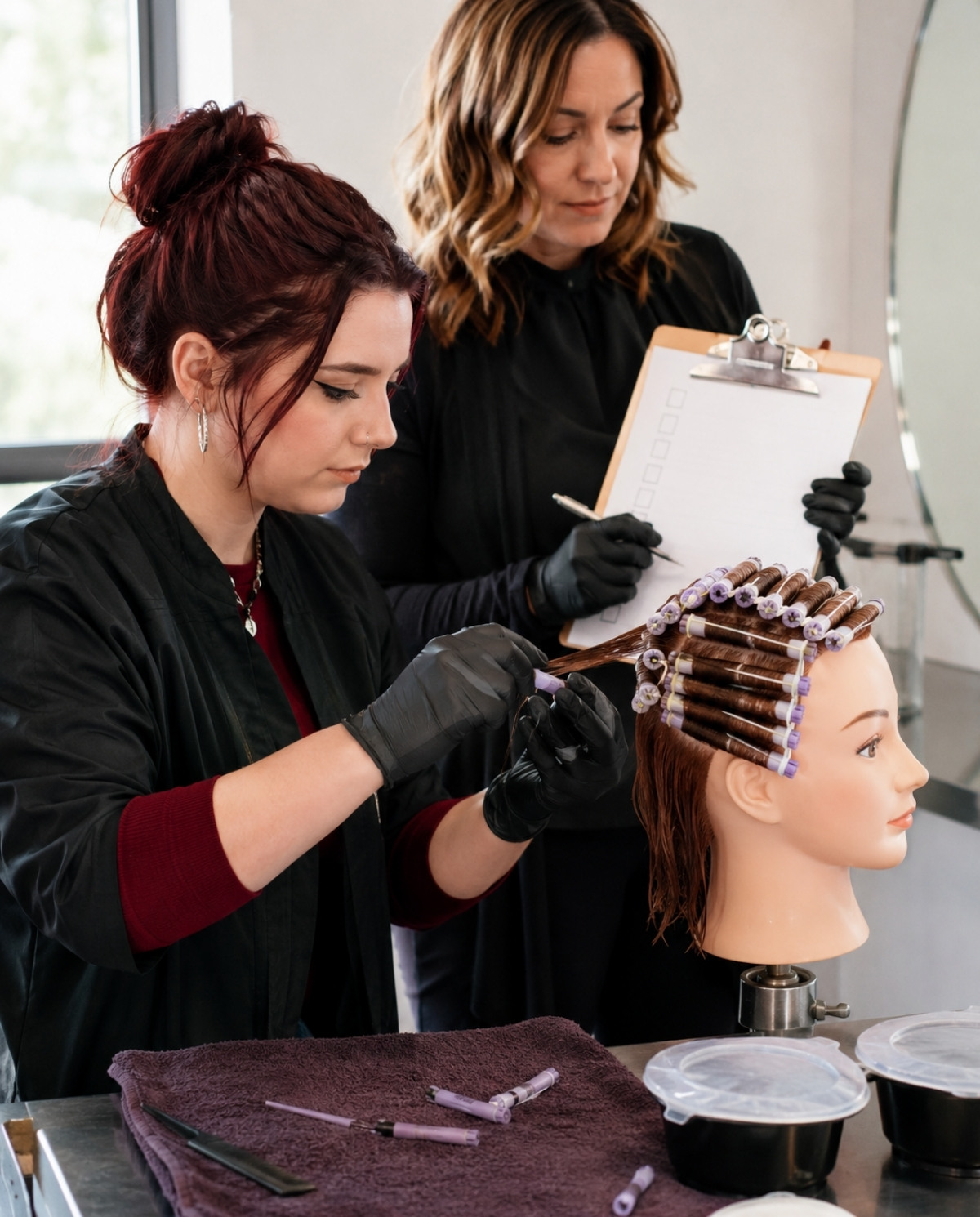
Cosmetology student practices chemical-texture rod placement on a mannequin while an instructor reviews blank competency boxes on a clipboard.

When researching how long you go to cosmetology school, you will quickly discover that these programs are not usually measured like conventional college degrees. Instead of relying primarily on credit hours, state licensing authorities commonly track progress through clock hours completed in a state-approved training program.

Under the federal definition, a clock hour can include a 50- to 60-minute class, lecture, recitation, faculty-supervised laboratory, shop-training activity, or internship within a 60-minute period. Schools must record student participation according to the state, accreditor, and federal financial-aid requirements that apply to the institution and program.

Before becoming eligible for an examination or license, students generally must complete the required time and curriculum components. Training may include classroom theory, instructor demonstrations, practical exercises, and supervised services in a student salon. Where permitted, approved distance education or externship activities may count toward certain portions of the curriculum.

School-based cosmetology requirements commonly fall between approximately 1,000 and 1,600 hours, although the precise curriculum and authorized services differ by state. California currently requires 1,000 hours, Georgia requires 1,500 hours, and Washington requires 1,600 hours. Apprenticeship pathways are separate and may involve different hour and supervision requirements.

For example, the official Georgia cosmetology curriculum rules establish a 1,500-hour school program. Arkansas also maintains a 1,500-hour curriculum for its school-based cosmetology pathway. At a scheduled pace of 30 hours per week, completing 1,500 hours takes about 50 instructional weeks before adding holidays, closures, absences, or other interruptions.

If you may relocate during or after school, reviewing a state-by-state guide to cosmetology training hours, examinations, and renewals can help you identify possible differences. A destination board or school evaluates prior education under its own rules and is not automatically required to accept every hour listed on an out-of-state transcript.

Start your research with the official licensing-board website for the state where you intend to qualify. The school’s approval status, required curriculum subjects, practical assignments, and attendance records can matter just as much as the overall hour total.

Licensing standards can also change. California’s SB 803 reduced the state’s cosmetology education requirement from 1,600 to 1,000 hours beginning January 1, 2022. Materials published by the California Board of Barbering and Cosmetology explain the hour reduction and elimination of the state practical examination. Because individual schools may offer programs longer than the state minimum, compare the institution’s approved course length before enrolling.

Comparing Full-Time and Part-Time Attendance

How quickly you finish depends heavily on the weekly schedule you select. Your preferred graduation date must often be balanced against employment, transportation, childcare, family responsibilities, and living expenses.

A basic estimate can be calculated by dividing the required program hours by your scheduled weekly attendance. Completing 1,500 hours at 30 hours per week, for example, requires 50 instructional weeks. That calculation does not account for school holidays, planned breaks, closures, absences, or available makeup dates.

Required Hours 40 Hours per Week 30 Hours per Week 20 Hours per Week 15 Hours per Week
1,000 hours 25 weeks About 34 weeks 50 weeks About 67 weeks
1,500 hours About 38 weeks 50 weeks 75 weeks 100 weeks
1,600 hours 40 weeks About 54 weeks 80 weeks About 107 weeks

These calculations provide an ideal starting point rather than a promised graduation date. The institution’s published calendar, weekly schedule, attendance policy, and makeup opportunities ultimately determine the practical timeline.

Reaching the Finish Line on a Full-Time Track

Full-time enrollment may suit students who want to complete their education efficiently and proceed to the licensing process sooner.

These schedules commonly involve approximately 30 to 40 hours each week and may resemble a conventional weekday work schedule. Exact attendance days, start times, and end times depend on the institution.

In a state with a 1,000-hour requirement, attending 30 to 40 hours each week produces a mathematical estimate of approximately 25 to 34 instructional weeks. After accounting for holidays, closures, and the academic calendar, a published program length of roughly 7 to 10 months may be realistic.

For a 1,500-hour pathway, the mathematical minimum is approximately 38 weeks at 40 hours per week or 50 weeks at 30 hours per week. Depending on the school’s calendar, this can place full-time completion near 9 to 14 months.

Regular attendance remains essential. Passing an examination or reviewing missed material independently generally does not remove absent hours from the attendance record. Any shortage normally must be completed through a makeup method authorized by the school and permitted under the applicable program and state rules.

Balancing School With a Part-Time Track

Part-time enrollment may be more manageable for students who need to continue working, care for family members, or handle other regular obligations.

These tracks may schedule approximately 15 to 20 hours per week through evening classes, shorter weekday sessions, or another arrangement offered by the institution. At 20 hours per week, a 1,500-hour course requires at least 75 instructional weeks. At 15 hours per week, the same program requires 100 weeks, which is nearly two years before breaks and absences are considered.

For this reason, part-time cosmetology education often takes approximately 14 to 24 months, and some schedules may take longer. Ask admissions for the institution’s published calendar rather than relying entirely on an hour-based calculation.

Certain schools offer approved online or hybrid instruction for theory subjects suited to remote learning. Availability depends on state-board rules, the school’s authorized program, accreditation requirements where applicable, and the system used to document participation. Hands-on services and other practical training generally must occur in an approved, supervised environment.

Before enrolling, ask which subjects may be completed remotely, how participation is recorded, and whether the delivery format changes the published completion date.

Reasons Your Expected Graduation Date May Change

A simple calendar calculation does not account for every circumstance that can arise during training. Because cosmetology programs may monitor attendance, curriculum completion, academic progress, and practical performance, reaching a particular month does not necessarily mean every graduation requirement has been satisfied.

Two prospective cosmetology students compare weekday and evening schedule options with an adviser beside an active training classroom.

How Absences Affect Required Training Time

Missing cosmetology school is different from missing a lecture in a conventional college course. Class notes may help you understand the material, but they generally do not replace required attendance hours.

If you miss an eight-hour day, those hours usually remain outstanding until they are completed through an authorized makeup arrangement. How quickly that happens depends on instructor availability, the institution’s policies, permitted daily attendance limits, and the frequency of makeup opportunities.

Missing a week will normally add at least the uncompleted hours to your remaining training. The actual calendar delay may be longer if makeup sessions are offered only on limited days.

Review the school catalog for information about:

  • Maximum permitted absences;
  • Authorized makeup procedures;
  • Charges for overtime or additional attendance;
  • Formal leave-of-absence procedures;
  • Policies for changing between day and evening schedules;
  • The maximum timeframe allowed for program completion.

Meeting Academic and Practical Benchmarks

Many schools require students to demonstrate basic sanitation knowledge and technical competence before serving clients on the student salon floor. Evaluations may address infection control, haircutting, chemical applications, styling, and safe workstation preparation.

For a closer look at the subjects covered during classroom and practical instruction, explore the technical, client-service, and business skills taught in cosmetology school.

Advancement standards are not identical across all schools. Depending on the catalog and applicable state curriculum, a student may need to repeat an assessment, complete additional practice, or finish required practical assignments before progressing. Ask the institution how unsuccessful assessments or unfinished services can affect the projected completion date.

Students using federal grants or loans must also meet their school’s satisfactory academic progress policy. Falling below required attendance, pace, or academic standards may affect financial-aid eligibility and, in more serious circumstances, the student’s ability to continue in the program.

Learning Safe and Legally Permitted Practices

Protecting clients is a foundational part of beauty education. Instruction commonly covers infection control, proper disinfection, safe product handling, basic skin and scalp awareness, and precautions associated with coloring, lightening, relaxing, and permanent-wave services.

State licensing boards establish the sanitation, curriculum, and professional-practice requirements that directly govern cosmetology schools and licensees. Federal agencies may provide additional product and workplace-safety standards, but their responsibilities are different.

For example, the FDA’s Modernization of Cosmetics Regulation Act of 2022 primarily establishes obligations affecting cosmetic manufacturers, processors, and responsible persons associated with cosmetic products. It does not replace state cosmetology-board rules or make individual students responsible for the law’s facility-registration and serious adverse-event reporting duties.

Students must also understand the legal limits of a cosmetology license. Advanced chemical peels, laser procedures, injectable treatments, and other medical-aesthetic services may fall outside a cosmetologist’s permitted scope. Depending on the state and procedure, a separate professional license, additional legal authorization, or medical supervision may be required. Completing a private training course or receiving a certificate does not automatically expand a person’s lawful scope of practice.

Managing the Physical Side of Salon Education

Salon training can place considerable demands on the body. Students may spend extended periods standing, bending, holding their arms above comfortable resting positions, and repeating small hand and wrist movements.

The National Institute for Occupational Safety and Health explains that awkward postures and repetitive movements can contribute to musculoskeletal problems in salon work. Adjustable seating, supportive footwear, properly positioned tools, good posture, and regular breaks can help reduce strain.

Physical discomfort does not automatically change a graduation date, but unmanaged pain or injury may make steady attendance more difficult. Developing better body mechanics during training can also support long-term health after entering the profession.

Moving to Another School or Changing Schedules

Transferring between institutions can change your timeline even when you possess an official transcript. The receiving school may evaluate the subjects completed, whether the previous institution was properly licensed or approved, the age of the training, and how closely the practical work matches its curriculum.

A receiving institution or licensing authority may recognize all, some, or none of the previous hours. Request a written transfer evaluation before leaving your current school or paying tuition to a new institution.

Changing from full-time to part-time attendance can also move the anticipated finish date considerably. Ask the administration to calculate an updated timeline based on the hours you have left and your revised weekly schedule.

Graduation Is Not the Same as Licensure

Completing the prescribed clock hours is a major accomplishment, but the last day of school and the date your professional license is issued may be different.

Depending on the state, graduates may still need to:

  • Submit an examination or license application;
  • Provide the required proof of completed education;
  • Pass a written examination;
  • Pass a practical examination where one remains required;
  • Pay testing and licensing fees;
  • Wait for the licensing authority to process the application and issue the credential.

Examination availability, processing times, missing documentation, and unsuccessful examination attempts can add time after graduation. Your legal ready-to-work date may therefore arrive several weeks or longer after your final day of training.

When planning your transition, estimate both the anticipated school completion date and the possible license-issuance date.

Evaluating the Value of Your Education

Cosmetology student compares a weekly school planner and work calendar at home with a mannequin head and professional tool case nearby.

Compared with a traditional four-year academic path, cosmetology school can offer a shorter route into a licensed occupation. However, financial results vary according to tuition, local demand, employment arrangements, specialty, experience, business costs, and the ability to attract and retain clients.

A strong program provides more than examination preparation. Supervised training gives students opportunities to improve technical consistency, client communication, infection-control habits, service timing, and confidence in a salon environment.

Possible career directions include salon employment, specialization in particular hair services, product or brand education, styling for media productions, booth or suite rental, and eventual business ownership. Certain paths may require professional experience, additional education, business registration, or separate licensing.

Before enrolling, compare the total program cost with the institution’s published disclosures. Determine whether the quoted amount covers:

  • Tuition, registration, and application fees;
  • Textbooks and digital learning materials;
  • Student kits and professional tools;
  • Required uniforms;
  • State examination fees;
  • Initial license-application fees;
  • Possible overtime or makeup-hour charges.

Review available completion rates, licensing-examination pass rates, and job-placement disclosures. State approval is important for meeting the applicable education pathway. If you plan to apply for federal aid, verify that both the institution and your specific program are eligible to participate in federal student-aid programs.

The U.S. Bureau of Labor Statistics Occupational Outlook Handbook projects 7% growth in overall employment of barbers, hairstylists, and cosmetologists from 2025 to 2035. It also projects approximately 80,300 openings each year, on average, during that decade. Many openings are expected to come from the need to replace workers who transfer to other occupations or leave the labor force.

These national projections point to continued occupational demand, but they do not guarantee a particular job, income, clientele, or business result. Individual opportunities still vary by location, specialty, licensing status, experience, and market conditions.

Common Questions About Cosmetology Program Length

Will Another State Accept My Completed School Hours?

Possibly, but approval depends on the receiving licensing authority and institution. National accreditation by itself does not guarantee automatic recognition of training completed elsewhere.

The receiving authority may consider whether the former school was properly licensed or approved, whether official records can be verified, and whether the completed subjects align with its curriculum. A student moving from a 1,000-hour state to a 1,500-hour state may need additional education, but the board or receiving school must first determine how many prior hours it will accept.

The transfer of unfinished education is also different from moving an active professional license. Licensed practitioners may qualify through endorsement, reciprocity, examination, work experience, or another process established by the destination state.

Do Cosmetology and Esthetics Require the Same Amount of School?

No. Cosmetology generally covers haircutting, styling, chemical hair services, and varying portions of nail and skincare education. Because it encompasses a broader range of services, school-based cosmetology programs commonly require approximately 1,000 to 1,600 hours.

Esthetics focuses more specifically on skincare, facials, hair removal, makeup, and other services allowed under state law. Requirements vary significantly. Georgia establishes a 1,000-hour esthetician school curriculum, while Arkansas uses a 600-hour school pathway for aestheticians.

Training length alone does not determine every service a graduate may legally provide. Compare the statutory scope of practice along with the required curriculum hours.

Is Federal Financial Aid Available With a Part-Time Schedule?

Eligible part-time students may receive federal financial aid when both the school and program participate in the relevant Federal Student Aid programs.

Pell Grant amounts may vary according to the student’s circumstances and enrollment intensity. Federal Direct Loans generally require at least half-time enrollment. For clock-hour programs, payment periods, attendance, academic progress, and the institution’s definition of its academic year may also affect aid disbursement.

The Federal Student Aid Handbook explains how enrollment intensity affects Pell Grant calculations. Consult the school’s financial-aid office before assuming that a particular part-time or evening schedule qualifies.

Can Online Classes Lower the Required Hour Total?

Generally, no. Authorized online theory allows certain activities to be completed away from campus, but those hours normally count toward the existing program requirement rather than reducing it.

The school must be permitted to offer distance education and must document participation properly. Required practical instruction must still be completed in an approved, supervised setting.

What Is the Best Way to Calculate My Finish Date?

Begin with the number of hours required by your state and subtract any transfer hours formally accepted by the receiving institution or board. Divide the remaining balance by your scheduled weekly attendance. Then account for school holidays, planned breaks, closures, expected absences, and a reasonable allowance for unexpected missed time.

For the most reliable estimate, request a written enrollment schedule that identifies the start date, weekly attendance commitment, published program length, makeup policy, and projected completion date.

Explore Your Training Options at Hogan Institute

Understanding the timeline makes it easier to decide how cosmetology education may fit alongside your current responsibilities. Hogan Institute of Cosmetology & Esthetics offers cosmetology training in Lilburn, Georgia, with classroom learning and practical experience designed to help students prepare for professional beauty work.

Visit the Hogan Institute Enrollment page to review admission requirements and request a campus tour. Because available schedules may change, contact the admissions team directly to ask about current class times, program formats, start dates, and the completion estimate that applies to your chosen schedule.

You can also complete the contact form at the bottom of the page to connect with the school and learn more about taking your next step.

How to Do Cosmetology After BDS: Training, Licensing, and Career Paths

Years spent working over dental chairs, handling insurance administration, and completing similar restorative treatments can make some clinicians wonder whether their skills could support another professional direction. Dentistry depends heavily on precision, but its physical demands and financial pressures can lead certain practitioners to consider facial aesthetics alongside conventional dental care.

Dentists receive substantial education in head and neck anatomy, facial muscles, nerve pathways, local anesthesia, occlusion, and the tissues surrounding the mouth. After completing procedure-specific education, this background may be relevant to treatments involving the lips, smile, lower face, and muscles used for chewing. Nevertheless, neither a dental degree nor a private course certificate automatically provides legal permission to offer aesthetic procedures. Practitioners must hold the required professional license and follow the scope-of-practice rules in the state where the treatment takes place.

This distinction is particularly important for international graduates researching how to pursue cosmetology after BDS. A foreign BDS alone generally does not authorize someone to practice dentistry or provide medical-aesthetic treatments in the United States. Internationally trained dentists must satisfy the licensing requirements of the state where they intend to work. In most states, this involves earning a DDS or DMD through a CODA-accredited pathway, frequently through an advanced-standing program, although specific requirements and limited alternative pathways vary by jurisdiction. In the United States, procedures involving neurotoxins and dermal fillers are normally categorized as facial aesthetics, medical aesthetics, or aesthetic medicine, not conventional cosmetology.

What Dentists Should Know First

  • Potential for Self-Pay Revenue: Cosmetic facial-aesthetic procedures are frequently paid for directly by patients, reducing insurance administration and eliminating dental laboratory charges for those services. Actual profitability still depends on product expenses, treatment time, inventory loss, liability insurance, marketing, follow-up appointments, and complication management.
  • Rules Change Across State Lines: Each state establishes its own legal boundaries. Georgia, for example, requires most eligible dentists to complete a Board-approved postgraduate course lasting at least 21 hours. It also restricts where and under what circumstances qualifying injectable procedures may be performed.
  • Dental Anatomy Is Only the Starting Point: Dentists have valuable knowledge of the head, neck, oral tissues, and perioral structures, but they still require procedure-specific education covering patient selection, injection methods, informed consent, adverse reactions, and emergency response.
  • A Certificate Cannot Enlarge a License: ADA CERP recognition, AGD PACE approval, and private training certificates may provide information about a continuing-education organization. They do not independently authorize treatment, guarantee acceptance by a dental board, or confirm malpractice coverage.

Defining the Legal Boundaries of Dental Aesthetics

Dentist and healthcare attorney reviewing a state map, license folder, and facial treatment-zone diagram at an office table.

How Existing Dental Education Applies

Dental education gives clinicians detailed knowledge of the facial and trigeminal nerves, facial musculature, circulation, occlusion, and structural relationships within the lower face. Dentists also administer local anesthesia and regularly evaluate interactions among the teeth, jaws, lips, cheeks, and muscles of mastication. These skills can help when examining perioral balance and the relationship between a patient’s smile and surrounding facial structures.

Even with that background, additional education remains essential. Fillers and neurotoxins involve distinct pharmacology, contraindications, injection planes, anatomical danger zones, consent requirements, and emergency procedures. A dentist must be competent in the particular treatment and remain within the purposes and anatomical areas authorized by state law.

The central legal issue is whether a proposed facial-aesthetic procedure falls within the dentist’s established professional scope. The United States has no single nationwide standard governing this question. Depending on the jurisdiction, a dental board may regulate the treatment area, clinical purpose, connection to dental care, required coursework, practice location, documentation, delegation, or permit status. Knowledge of facial anatomy does not create legal authority when a state’s laws exclude the procedure.

Some jurisdictions allow properly trained dentists to provide defined cosmetic and therapeutic services within oral and maxillofacial regions. Others restrict dentists to the lips, cheeks, jaws, oral cavity, associated tissues, or treatments directly connected to a dental procedure. Dentists should confirm the exact boundaries through current statutes, administrative regulations, official board policies, or written guidance.

Examples of how state requirements differ include:

  • Georgia: Georgia Rule 150-14-.04 allows licensed dentists who satisfy its requirements to administer qualifying injectable pharmacologics for functional or cosmetic enhancement of the gums, cheeks, jaws, lips, oral cavity, and associated tissues. The treatment must be connected to a dental procedure and performed in a dental treatment setting. Unless the dentist completed an ADA-accredited oral and maxillofacial surgery advanced specialty program, a Board-approved postgraduate course of at least 21 hours is required. The dentist must send the Board a certified true copy of the course-completion certificate within 30 days, complete the required patient assessment, document the treatment, and personally administer the injectable without delegating it.
  • Arkansas: Arkansas has previously indicated that dentists with suitable education may perform certain botulinum-toxin and dermal-filler procedures as part of dental practice. However, publicly available Arkansas rules do not establish an injectable framework as detailed as Georgia’s. Before obtaining products, promoting treatments, or treating patients, an Arkansas dentist should request up-to-date direction from the Arkansas State Board of Dental Examiners.

These jurisdictional differences should be investigated before any aesthetic service is introduced. Beauty professionals may consult a state-by-state cosmetology license guide covering training hours, examinations, and renewals, while dentists must examine the separate requirements established by their dental board. A foreign BDS, US dental license, cosmetology license, and private aesthetics certificate are different credentials and do not create the same professional authority.

When Functional Care and Cosmetic Results Overlap

A single treatment may sometimes have both therapeutic and cosmetic effects. Some clinicians use botulinum toxin off-label in carefully selected patients with overactive chewing muscles, masseter hypertrophy, bruxism, or particular temporomandibular disorders. Reducing the activity of an enlarged or overactive masseter may provide a functional benefit and can also produce a narrower-looking lower face over time.

These applications are not universally approved, suitable for every patient, or automatically included in every dentist’s scope. The temporomandibular joint is the physical joint, commonly abbreviated as TMJ, while conditions involving this system are generally called temporomandibular disorders, or TMD. In the United States, botulinum-toxin treatment for bruxism and many TMD-related uses is generally off-label because those purposes are not specifically listed in the product’s FDA-approved labeling.

A licensed professional may sometimes use a product off-label when there is an appropriate clinical basis, but off-label use does not bypass state law. The clinician must have the necessary authority and competence, obtain informed consent, and maintain proper records.

Calling a cosmetic procedure therapeutic does not make an otherwise unauthorized service legal. Similarly, mentioning a vague connection to smile enhancement cannot expand a dentist’s permitted scope. The diagnosis, treatment site, clinical purpose, consent documents, patient record, and advertising must truthfully reflect the service being provided.

The discussion published by Oberman Law Firm provides general background on how jurisdictions approach injectable treatments in dental practices. However, a private legal article is an interpretation rather than an official source of law. Current statutes, administrative rules, dental-board guidance, and advice from a qualified healthcare attorney should take priority whenever the permitted scope is uncertain.

Evaluating Postgraduate Training Options

The postgraduate training market contains brief workshops, online lessons, tiered certificate courses, and privately named programs advertised as a fellowship in medical cosmetology after BDS or a diploma in facial cosmetology after BDS. These labels are not used consistently. Unlike a state-issued dental license or a CODA-accredited dental specialty, terms such as certificate, diploma, and fellowship do not have a standardized meaning throughout the private facial-aesthetics education industry.

A beginner course might take one day or several days and introduce facial anatomy, consultation methods, basic neurotoxin or filler concepts, and early recognition of complications. A longer program may continue for several months and include additional treatment areas, supervised patient participation, case discussions, skin procedures, and mentorship. Program length alone does not prove that the education is comprehensive, clinically adequate, or accepted by a licensing board.

Before registering, determine:

  • Whether the relevant dental board accepts the education provider and curriculum
  • Whether the curriculum meets every required subject and minimum training hour
  • How the program divides its time among lectures, simulation, observation, and hands-on participation
  • Whether any clinical component uses properly screened live patients
  • Whether instructors hold suitable licenses, qualifications, and experience
  • Whether the program addresses anatomy, dosing, contraindications, consent, product handling, and complication response
  • Whether continued clinical guidance is available after the introductory training
  • Whether the dentist’s professional liability insurer considers the training sufficient

Chemical peels, microneedling, facials, lasers, and other skin services should each be investigated individually. Permission to administer certain injectables under a dental license does not necessarily include laser treatment, unrestricted skin procedures, or the general services performed by licensed estheticians. Conversely, cosmetology and esthetics licenses generally do not give a person authority to prescribe or inject dermal fillers or neurotoxins.

Beauty professionals face a different regulatory framework when determining whether they may provide esthetics, barbering, lash, or nail services under a cosmetology license. Dental education does not automatically grant the legal privileges of a cosmetologist or esthetician. Beauty-school education also cannot enlarge the medical or dental authority established by a dentist’s professional license.

The Value of Closely Supervised Practice

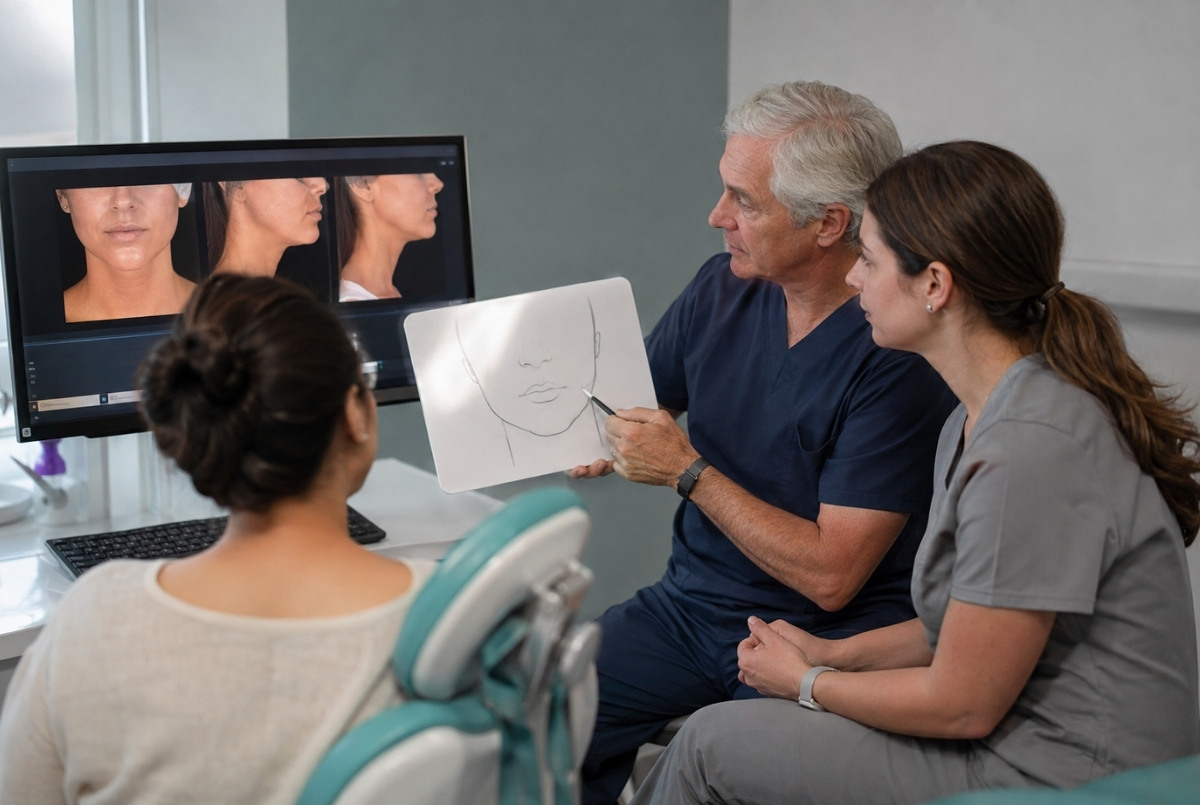
Senior clinician, dentist learner, and adult patient reviewing lower-face assessment photographs during a supervised feedback session.

Digital courses can support the study of anatomy, pharmacology, skin biology, consent, and the theoretical management of complications. However, an online lesson cannot fully reproduce the physical judgment required to evaluate tissue, select and control injection depth, monitor how a product behaves, or manage an unexpected patient response in real time.

Injectables and skin treatments should not be treated as one interchangeable skill. Filler procedures require detailed understanding of vascular structures, tissue planes, product properties, and the response to suspected vascular occlusion. Neurotoxin treatment involves muscle function, dosing, diffusion, contraindications, and the prevention or correction of unwanted asymmetry. Microneedling and chemical peels introduce separate considerations involving skin type, treatment depth, infection prevention, pigment changes, wound healing, and aftercare.

Dentists comparing courses may consider continuing-education organizations recognized through the American Dental Association’s Continuing Education Recognition Program or approved through the Academy of General Dentistry’s Program Approval for Continuing Education. These designations must be interpreted correctly. ADA CERP applies recognition to continuing-education providers, not to each individual course, procedure, or technique. The program also explains that recognition does not guarantee a state dental board will accept the credit. In the same way, AGD PACE evaluates and approves continuing-education organizations rather than separately endorsing every treatment taught by those organizations.

Verification should therefore occur with both the regulator and the insurer. Before paying for a program, ask the dental board whether the proposed course fulfills its requirements. The dentist should also provide the curriculum and clinical-training details to the professional liability carrier and ask what evidence the carrier requires.

Filler-related vascular occlusion deserves significant attention in clinical education. The US Food and Drug Administration warns that filler accidentally introduced into a blood vessel can obstruct circulation and result in tissue death, visual impairment including blindness, or stroke. These complications are uncommon, but the harm can be severe and permanent.

A suitable curriculum should cover early warning signs, product-specific response plans, emergency equipment, consent, documentation, referral arrangements, and immediate escalation for visual symptoms or evidence of tissue ischemia. A completed course does not guarantee insurance coverage. Nevertheless, relevant and documented clinical education may be among the requirements considered by an insurer or regulatory board.

Assessing the Business Side of Aesthetic Services

Dentist reviewing a planning board and budget sheet beside a treatment room, consultation chair, and organized clinical supplies.

Insurance administration, slow third-party reimbursement, and dental laboratory charges can create financial pressure in general dentistry. Cosmetic facial-aesthetic procedures are often self-pay, so those particular treatments may require less insurance billing and normally do not involve dental laboratory expenses.

Self-pay status does not mean that every treatment will produce a high profit. The practice must account for product purchases, storage conditions, expiration dates, unused inventory, disposable supplies, employee education, appointment length, insurance premiums, advertising, follow-up care, refunds, and the resources needed to address complications.

A practical estimate should begin with:

  • Revenue actually collected minus the cost of the treatment product
  • Minus inventory that expires or must be discarded
  • Minus staff time and clinical materials
  • Minus advertising and professional liability expenses
  • Minus the cost of follow-up appointments and adverse-event management

Financial planning should be based on the practice’s real treatment capacity, local prices, patient demand, and product usage. Revenue promises published by training providers should not be treated as reliable projections for an individual dental office.

What Procedure Statistics Reveal About Patient Interest

Minimally invasive cosmetic procedures appeal to many patients partly because recovery is usually shorter than it is after surgery. Certain fillers can produce a visible change immediately, although temporary swelling may alter the initial result. Neuromodulator effects generally emerge over several days. Results from peels and skin-remodeling treatments may develop more gradually.

The American Society of Plastic Surgeons reported nearly 25.4 million cosmetic minimally invasive procedures in 2023. Its total included 9,480,949 neuromodulator injections and 5,294,603 hyaluronic-acid filler procedures. The figures demonstrate considerable overall demand, but they do not establish how many patients will seek treatment from dentists or how profitable these services will be for a particular practice.

Patients may consider their teeth and smile within the appearance of the entire face. A person receiving veneers or clear aligners might also raise concerns involving lip volume, lines around the mouth, facial symmetry, or skin texture. If the dentist holds the appropriate license, has completed suitable procedure-specific education, carries the necessary insurance, and is authorized under state law, selected facial-aesthetic services may be discussed within an existing professional relationship.

Chemical peels do not create the same effects at every treatment depth. Their action depends on factors such as the chemical agent, formulation, concentration, contact time, and intended penetration. A superficial peel may mainly address surface texture or pigmentation. Deeper controlled treatments can produce more extensive remodeling but also involve greater risk and a longer recovery period.

Commercial research from Fortune Business Insights estimates that nonsurgical facial treatments represent nearly 61% of aesthetic procedures performed in the United States. This percentage comes from a commercial market report rather than a national clinical registry, so it should be treated as an industry estimate instead of a precise official count.

The American Academy of Facial Esthetics reports that a typical dentist member adds approximately $30,000 per month in production after combining facial-pain treatment, facial aesthetics, and dental sleep-medicine services. This figure is promotional, comes from the organization itself, and covers multiple types of treatment. It is not an independently verified measure of injectable revenue. In addition, production refers to gross treatment value, not net profit or personal income. The claim should therefore not be used as a guaranteed financial forecast.

Creating a Responsible Entry Strategy

A gradual, organized approach can help dentists protect their patients, professional licenses, and practices when expanding into facial aesthetics.

Begin by confirming licensure and legal authority. Internationally educated BDS graduates should identify the full pathway required to obtain a dental license in the jurisdiction where they plan to practice. Dentists who are already licensed should ask their state board about permitted products, purposes, anatomical regions, treatment locations, course requirements, documentation, permits, and delegation. Written board guidance is preferable when published rules do not provide a clear answer.

Next, evaluate clinical education. The chosen dental or medical continuing-education provider should offer qualified instructors, appropriate clinical participation, and emergency education that meet the dental board’s standards. The curriculum should address patient selection, health screening, contraindications, informed consent, facial and vascular anatomy, product storage and handling, treatment planning, clinical records, adverse reactions, vascular-occlusion management, and referral procedures.

Professional liability coverage should then be confirmed separately. A standard dental malpractice policy may not cover cosmetic injectables, lasers, peels, or other aesthetic services. The dentist should give the insurer a written description of the products, procedures, treatment sites, training, and clinical setting. Written confirmation should be obtained before the service is advertised or performed. Depending on the policy and carrier, coverage may already apply, require an endorsement, undergo separate underwriting, contain restrictions, or be excluded.

The practice must also establish treatment-specific systems. These may include consent documents, medical-history screening, standardized photographs, lot-number and expiration records, follow-up procedures, emergency supplies, adverse-event protocols, and relationships with appropriate referral providers. Employees should know how to identify urgent symptoms and follow the escalation plan.

If every legal, educational, and insurance requirement has been satisfied, the service can be introduced gradually within the existing practice. Appropriate patients might first receive information during consultations involving smile design or facial balance. Treatment should proceed only after a complete assessment, accurate documentation, informed consent, suitable scheduling, and confirmation that the requested service remains within the dentist’s authorized scope.

Common Questions From Dentists

Must I leave general dentistry to enter facial aesthetics?

No. Some dentists add legally permitted facial-aesthetic procedures to an existing dental practice. Whether they may do so depends on state law, the treatment purpose, anatomical location, required education, clinical setting, and insurance coverage. Dedicated appointment sessions may provide more time for consultation, medical assessment, photographs, consent, treatment records, and follow-up.

How does an introductory workshop differ from a privately named fellowship?

A short workshop may introduce anatomy, consultation, product fundamentals, and basic techniques. A more extensive program might include supervised patient participation, advanced planning, complication response, case analysis, mentorship, or separate skin procedures. The label fellowship does not automatically indicate a CODA-accredited specialty or a credential accepted by a licensing board. Dentists must evaluate the actual curriculum and its regulatory acceptance.

Are aesthetic treatments included in ordinary dental malpractice coverage?

Not necessarily. Coverage depends on the insurer and the individual policy. Before providing treatment, the dentist should disclose the procedures, products, anatomical locations, education, and practice environment and obtain written confirmation from the carrier. Completing education through an ADA CERP-recognized or AGD PACE-approved provider does not independently guarantee coverage.

May a dental hygienist or assistant administer the injections?

Delegation requirements differ considerably among jurisdictions and licensed professions. Georgia Rule 150-14-.04 specifically prevents dentists from delegating administration of the injectable pharmacologics covered by that rule. In other states, dentists must determine whether hygienists or assistants may administer each individual product and what supervision, permits, or education would be necessary. Botulinum toxin is a prescription biologic drug, while dermal fillers are generally regulated as medical devices, so their legal treatment should be examined separately.

Does earning a facial-aesthetics certificate increase my permitted scope?

No. Education may develop clinical competence and provide documentation of training, but it cannot increase the authority granted by law. The procedure must already fit within the dentist’s licensed scope, and the education must satisfy any additional standards imposed by the dental board.

Can a dentist trained outside the United States begin after earning a private certificate?

Generally, no. A private course does not replace the dental or medical license required in the jurisdiction where a patient is treated. International BDS graduates must first determine how to qualify for professional licensure and then confirm the additional facial-aesthetics requirements established by the relevant board.

Prepare Carefully Before Expanding Your Services

Moving beyond conventional dental treatment into facial aesthetics requires much more than introductory knowledge. A practitioner needs an active professional license, confirmed legal authority, procedure-specific competence, emergency preparation, appropriate clinical systems, and written confirmation of professional liability coverage.

Hogan Institute of Cosmetology and Esthetics provides education for beauty-industry careers, including cosmetology and esthetics. Its programs are not dentist-specific injectable courses, advanced-standing dental programs, or substitutes for authorization from a state dental board. Dentists interested in neurotoxins, fillers, or other medical-aesthetic procedures must select education appropriate for their professional license and accepted by the relevant regulator.

If your goals involve professional cosmetology or esthetics education, visit our Enrollment page to review how to get started. You may also complete the contact form below, and our team can answer questions about Hogan Institute’s available beauty programs.

Moving States With a Cosmetology License: Transfer Rules, Exams, and Hour Gaps

Main Points to Know

  • Reciprocity and Endorsement: Licensing boards apply these terms differently. Both can provide a route to licensure based on an existing out-of-state credential, but every state establishes its own documentation, examination, and experience requirements.
  • Multistate Licensing: Twelve states have enacted the Cosmetology Licensure Compact. However, the compact is not operational yet, and multistate cosmetology licenses are not currently available.
  • Differences in Training Hours: Moving to a state with a higher education requirement does not always require returning to school. Some boards may consider an active license, previous examinations, or verified work experience instead of requiring every additional training hour.
  • Official Documentation: Licensing boards may require certifications and supporting records to come directly from the issuing board, beauty school, examination provider, or another approved source. Submission procedures and processing times vary by state.

Moving across state lines can bring exciting opportunities for a beauty professional, but navigating a cosmetology license transfer from state to state online can become frustrating quickly. Complicated board websites and conflicting advice can leave you unsure about what to do before your relocation even begins.

Fortunately, moving your career usually does not mean repeating your education from the beginning. Understanding how the destination board evaluates your license, training, examination history, and professional experience makes the process far easier to manage.

How States Define Reciprocity and Endorsement

Cosmetologist calling a licensing board while reviewing her active credential, verification request, application requirements, and planner.

Two terms appear repeatedly when researching license portability: reciprocity and endorsement. Although they are sometimes treated as entirely different procedures, licensing boards do not apply these labels consistently.

Reciprocity can refer to a state recognizing a credential issued by another jurisdiction. In certain professions, the term describes a formal agreement between two states. In the beauty industry, however, a board may call its general out-of-state licensing process reciprocity even when no mutual agreement exists.

Endorsement generally involves a destination board granting a new license based partly on the credential an applicant already holds. The review may consider the applicant’s current license status, original education, examination history, professional experience, disciplinary record, or a combination of these factors.

Official terminology demonstrates this inconsistency. The Georgia State Board of Cosmetology and Barbers explains that Georgia does not reciprocate with other states, although actively licensed professionals may apply by endorsement. In contrast, the Nevada State Board of Cosmetology identifies its out-of-state pathway as reciprocity.

For this reason, review the destination board’s actual application instructions instead of relying on the name assigned to the process.

Many boards accept online applications, but supporting materials may follow separate submission procedures. Your original licensing board, beauty school, examination provider, or former employer may need to send verified records directly to the destination board.

What to Expect From the Cosmetology Licensure Compact

The Cosmetology Licensure Compact is intended to provide an additional licensing option for qualified cosmetologists who want to work in multiple participating states. However, enactment of the compact by individual states does not mean multistate licenses are already available.

According to the Council of State Governments National Center for Interstate Compacts, twelve states have enacted the compact: Alabama, Arizona, Colorado, Delaware, Kansas, Kentucky, Maryland, Ohio, Pennsylvania, Tennessee, Virginia, and Washington.

The official Cosmetology Licensure Compact website explains that the compact is not operational yet. Member states are not currently issuing multistate licenses, so professionals must continue using the existing reciprocity, endorsement, or out-of-state process of each destination state.

Once implementation is complete, eligible cosmetologists will be able to apply for a multistate license through their home state. Applicants must reside in a compact member state, hold an active and unencumbered home-state cosmetology license, and pay the required fees.

An unencumbered license is active and is not currently suspended, revoked, restricted, or subject to conditions that limit the professional’s authority to practice. It does not necessarily mean that the license holder has never had a complaint or disciplinary matter that was resolved previously.

A multistate license will authorize practice in other participating states, but licensees must still comply with the scope-of-practice, safety, and professional-conduct requirements of the state where each service is provided.

What a Destination Board May Examine

Each licensing board creates its own standards for protecting consumers and determining whether an out-of-state applicant qualifies. When reviewing cosmetology license transfer from state to state requirements, expect the board to consider some combination of the following:

  • Current License Standing: Many reciprocity and endorsement pathways require an active license in good standing. Someone with an expired credential may be directed to reinstatement, examination, or another licensing route.
  • License Certification: A board may require official documentation of your license type, status, issue date, disciplinary history, and how you originally qualified.
  • Training and Test Records: Depending on the state, you may need school transcripts, curriculum records, or official proof of passing an accepted written or practical examination.
  • Identification and Required Disclosures: Application materials may include government identification, a Social Security number or another accepted tax identifier, lawful-presence documents, and disclosures involving criminal convictions or professional discipline.
  • Local Examinations: Acceptance of your professional examination does not always eliminate additional testing. A destination state may require a test covering its laws, sanitation standards, or professional regulations.
  • Application-Related Costs: In addition to an application fee, expenses may include license certification, examination fees, fingerprinting, document translation, or a temporary permit.

Nevada, for example, charges a nonrefundable $325 reciprocity application fee. Applicants must also pass a 25-question Nevada State Law Test with a score of at least 75 percent, according to the Nevada State Board of Cosmetology.

Before submitting your application, use our detailed state-by-state cosmetology license guide to compare education, testing, and renewal rules. Always verify the final requirements directly with the destination board because fees, laws, and application procedures can change.

Why a License Card May Not Be Enough

A wall license or wallet card generally does not contain all the information needed for an out-of-state application. A board may request official records documenting when your license was issued, whether it remains active, how you originally qualified, and whether it has been restricted or disciplined.

The correct submission procedure depends on the jurisdictions involved. California generally requires certification to be sent directly by the issuing state, as explained in the California Board of Barbering and Cosmetology reciprocity FAQ.

Nevada follows more than one verification method. Its board can check licenses online for applicants from many states, while professionals from certain other jurisdictions must arrange for direct certification. Therefore, applicants should not assume that every board requires the same state-to-state document process.

Processing times also differ. Missing certifications, incomplete examination records, name inconsistencies, disciplinary reviews, and licensing histories involving multiple states can cause delays. Request required records early, but use the destination board’s current processing information when estimating your timeline.

How Boards Address Unequal Training Hours

Returning cosmetology professional practicing technical hair sectioning on a mannequin during a supplemental evening class required to address a training-hour difference.

A higher education requirement in the destination state does not automatically create an hour-for-hour shortage that every transferring professional must complete.

New York, for example, requires 1,000 hours for its cosmetology school pathway, while Georgia requires 1,500 hours for students completing a Georgia cosmetology program. That difference does not automatically force every licensed New York cosmetologist relocating to Georgia to complete another 500 hours.

The Georgia State Board of Cosmetology and Barbers states that someone holding an active out-of-state license may apply by endorsement even when the applicant completed fewer school hours than Georgia requires.

This distinction matters because requirements for first-time applicants are not necessarily identical to those used for already licensed professionals. Initial licensing rules explain how a new applicant qualifies, while endorsement rules determine how the board evaluates an existing out-of-state credential.

Depending on the destination state, a professional with fewer original training hours may qualify through one of the following approaches.

1. Evaluation Based on an Existing License

Some boards give significant consideration to whether an applicant already holds a current, unrestricted out-of-state license rather than requiring an exact match between school-hour totals.

California illustrates this approach. Its board may grant a license through reciprocity without requiring the California written examination when an applicant holds a qualifying out-of-state license that is active, unrestricted, and in good standing. Details are available through the California Board’s reciprocity guidance.

Education can still matter during the review. A board may investigate how the original credential was earned, particularly when the applicant received that license through reciprocity from another jurisdiction.

2. Using Professional Experience Toward Eligibility

Some states permit documented professional experience to compensate for part of a training difference or help an applicant qualify through an examination pathway.

There is no nationwide formula for experience credit. California, for example, allows every three full months worked as a licensed professional to count as 100 hours of training for certain out-of-state examination applicants. This formula appears in the California Board’s license requirements.

A destination board that accepts experience may request employer affidavits, tax records, pay statements, business documentation, or license-history records. Submit these materials only when the applicable instructions require them.

3. Completing Only the Additional Education Required

If the destination board determines that more education is necessary, an applicant may not have to repeat the complete cosmetology program. A state-approved school may be able to review the previous transcript and award eligible transfer credit.

However, applicants and schools cannot independently decide that every previously completed hour will count. The amount of credit available depends on the destination state’s regulations and the receiving school’s approved transfer policy.

Before enrolling, ask the licensing board whether supplemental hours are required, which subjects must be completed, and whether the education must be taken through a school approved by that state. Whenever possible, obtain written confirmation before paying tuition.

4. Meeting Additional Testing Conditions

A licensing obstacle is not always caused by an education-hour difference. The destination board may instead need proof that an applicant passed an accepted professional examination or understands local laws and regulations.

Nevada requires reciprocity applicants to complete its state-law test. Georgia may require additional testing when an applicant cannot document passing an accepted written and practical examination. Other boards may require a theory test, practical examination, jurisprudence test, or more than one testing component.

Because these requirements are separate from education-hour totals, investigate them early in the relocation process.

Why Matching the Numbers Is Not Sufficient

Comparing two hour requirements does not reveal everything a board may consider. A licensing review can also involve current license standing, years of professional practice, examination history, license classification, and authorized services.

Two states may use similar license titles while permitting different services. Nevada, for example, states that it does not recognize the Florida Full Specialist credential because its education and scope are not comparable to Nevada’s separate esthetics and nail-technology licenses.

For that reason, compare the actual license categories and legally authorized services in both states rather than focusing only on education totals.

Examples From Georgia and Arkansas

These examples demonstrate how differently boards may evaluate licensed professionals arriving from other states:

  • Georgia: The Georgia State Board of Cosmetology and Barbers explains that Georgia does not maintain direct reciprocity with other states. An active licensee in good standing may apply by endorsement, including an applicant whose original education involved fewer hours. Additional testing generally is not required when the applicant can document passing a national or state-approved written and practical examination in English. Someone who has held licenses in multiple states must arrange for verification from every state. Georgia licensees generally complete five continuing education hours for renewal, although exemptions and waivers apply to certain licensees. Under the current Georgia rules, three of the five hours must cover approved health and safety education, while the other two may address approved professional subjects.
  • Arkansas: Arkansas requires 1,500 hours for its initial cosmetology school route, but out-of-state licensees use a separate reciprocity process administered by the Arkansas Department of Health Cosmetology Section. Applicants should follow the current reciprocity instructions instead of treating the initial 1,500-hour requirement as an automatic training deficit. Arkansas testing information also includes a state-law component, as shown in the Arkansas cosmetology candidate bulletin. Because documentation and testing requirements may depend on how the original license was earned, applicants should request an individual determination before enrolling for more education.

Situations That Could Require Another Licensing Exam

Cosmetologist organizing license verification, education records, identification documents, and a practical examination kit for an interstate license-transfer application.

The destination board determines whether an applicant must complete another written, practical, or state-law examination. The decision is not based solely on the organization that developed the original test.

Many states use one or more examinations created by the National Interstate Council of State Boards of Cosmetology, commonly called NIC. Nevertheless, NIC use is not uniform. A jurisdiction may adopt the NIC theory examination, its practical examination, both components, or a different testing system.

Passing an NIC examination in one jurisdiction does not guarantee that another board will accept the result. The destination board decides whether the previous test meets its requirements and whether an official score report is necessary.

The NIC testing maps show the different boards and examination providers used nationwide. Before relocating, ask the destination board:

  • Which written and practical examinations qualify for reciprocity or endorsement?
  • Must those examinations have been completed in English?
  • Who must send the official score report?
  • Is there a separate state-law or jurisprudence examination?
  • Is retesting required if the original jurisdiction did not use a practical examination?

Georgia generally does not require additional testing when an endorsement applicant proves that they passed a national or state-approved written and practical examination in English. Nevada requires a state-law test and may require other examinations depending on the applicant’s qualifications.

California demonstrates why broad assumptions about testing systems can be inaccurate. The state stopped requiring practical examinations for its license categories on January 1, 2022, according to the California Board of Barbering and Cosmetology. Qualifying out-of-state licensees may also receive a California license through reciprocity without completing the California written examination.

If retesting becomes necessary, our cosmetology licensing exam guide can help you review theory topics, practical testing, and test-day preparation. You should still download the current candidate bulletin for your destination state because its tested components and procedures may differ.

Preserve Proof of Your Previous Examinations

A license card may not show which examination components you completed. When a destination board requires proof of a written, practical, national, or state-approved examination, you may need an official score report or a detailed certification from the original licensing authority.

These records are especially important for professionals who have been licensed for many years, completed testing through a company that has since changed, or obtained their current license through reciprocity rather than examination.

Requesting the information before relocating can help you determine whether another examination is necessary while your original school, licensing board, and testing provider are still easier to contact.

Organizing Your Transfer From Start to Finish

A structured plan can reduce administrative problems and help you avoid an unexpected interruption in employment:

  1. Match the License Categories: Confirm that your current credential corresponds to the license you are seeking. Compare both the title and the legal scope of practice.
  2. Review the Board’s Official Instructions: Find the current application checklist for reciprocity, endorsement, or out-of-state applicants.
  3. Document Your Testing History: Identify the written and practical examinations you passed and determine whether the destination board accepts them.
  4. Order License Certifications: Follow the destination board’s directions for online verification or official certification from every relevant licensing jurisdiction.
  5. Collect Other Materials When Requested: Additional records may include school transcripts, curriculum details, score reports, name-change documents, employment affidavits, tax records, disciplinary orders, or certified translations.
  6. Request an Evaluation of Any Hour Difference: Do not enroll in supplemental education until the licensing board confirms whether additional hours are required.
  7. File the Application and Pay the Required Fees: Submit every required item and monitor your account for deficiency notices or requests for more information.
  8. Maintain Your Original Credential: When possible, keep your existing license active until the destination license is granted. Many streamlined pathways depend on an active credential.
  9. Do Not Work Without Authorization: A submitted application, pending status, or examination approval may not provide legal authority to serve clients. Wait until the destination state issues a license or valid temporary permit.

Portability Pathways for Military Households

Active-duty service members and military spouses may qualify for expedited processing, temporary recognition, fee reductions, or other licensing-portability protections. These options operate separately from standard reciprocity and endorsement procedures.

Eligibility can depend on military orders, residence, current license status, state law, and whether the relevant professions are considered substantially similar. Military applicants should review the destination board’s military guidance and any applicable federal portability protections before filing a standard application.

Preparing for a Career That Crosses State Lines

Navigating different licensing systems reveals an important reality: the quality of your initial training and the records you preserve can affect your professional mobility long after graduation.

Completing a program approved by the appropriate state licensing authority helps demonstrate that your education satisfied the requirements associated with your original credential. Accreditation can provide separate academic or financial-aid advantages, but it does not guarantee that another board will accept every hour or issue a license automatically.

A strong beauty program provides more than technical instruction. Students also need a working understanding of sanitation, chemical safety, client consultation, professional conduct, and the limits of their legally authorized scope of practice.

Keeping organized records is equally valuable. Retain personal copies of your transcript, curriculum information, examination results, original license documents, legal name-change records, and continuing education certificates. Replacing these materials can become difficult many years after graduation.

If you are preparing to enter the industry or planning your next career move, our guide to your options after beauty school can help you coordinate training, licensing, employment, and long-term professional goals.

Questions Professionals Commonly Ask

Is there a standard timeline for transferring a beauty license?

No national processing timeline applies to every transfer. The wait depends on the destination board, whether the application is complete, how quickly licensing records are verified, whether testing is required, and whether the file needs additional review.

Missing records, inconsistent names, multiple previous licenses, or unresolved disciplinary documentation may extend the process. Review the board’s current processing information before committing to an employment start date.

May I serve clients while the application is pending?

Only when the destination state has issued an active license, temporary permit, or another form of legal authorization that permits you to work.

Submitting an application, receiving examination approval, or seeing a pending portal status generally does not authorize professional services. Working without the required credential can result in fines, disciplinary consequences, or complications with the pending application.

What happens if my first state required less education?

Do not immediately enroll in another school. Ask the destination board how it evaluates licensed out-of-state applicants and whether it requires an individual review.

Depending on the applicable rules, your active license, accepted examinations, verified experience, supplemental education, or another pathway may satisfy the destination state’s requirements. Obtain written guidance before paying for additional training.

Are NIC results automatically recognized in another state?

No. A previous NIC result may meet another board’s requirements, but recognition is not automatic. The destination board determines which examination components it accepts and whether an official score report or additional test is needed.

Does every cosmetology license authorize nail and skin-care work?

No. Cosmetology licenses commonly cover certain hair, nail, and skin-care services, but the precise scope differs between states and may be narrower than the authority granted under separate esthetician or nail-technician licenses.

Advanced exfoliation, lasers, deeper chemical treatments, and certain cosmetic devices may require separate government-issued credentials or may be restricted to appropriately licensed medical professionals. Follow the scope-of-practice laws of the state where the service is performed.

Can the compact be used in all twelve participating states today?

Not yet. Twelve states have enacted the compact, but multistate cosmetology licenses are not currently being issued. Until implementation is complete, professionals must continue using each state’s existing out-of-state licensing process.

Once multistate applications become available, eligibility will depend on requirements including residence in a compact member state, an active and unencumbered home-state license, and payment of applicable fees.

Take Your Beauty Career Wherever Opportunity Leads

At Hogan Institute of Cosmetology and Esthetics, education extends beyond preparation for a licensing examination. Our training emphasizes practical experience, technical development, health and safety, and the professional confidence needed to pursue long-term opportunities in the beauty industry.

With more than 20 years in business and a team offering extensive industry experience, Hogan Institute provides hands-on, salon-focused education designed to help students become prepared for professional environments. No beauty school can promise that a credential will transfer automatically to every jurisdiction, but completing proper training and maintaining accurate records can make future licensing applications easier to manage.

Visit our Enrollment page to explore the application process and available training options. You may also use the contact form below to ask questions about programs, scheduling, campus visits, or your next steps.

From Hair to Business: What You Learn in Cosmetology School

What You Should Know Before Starting

  • A Broad Beauty Education: Cosmetology training extends well beyond cutting and styling, with coursework that can include chemical texturizing, hair color, introductory skin care, makeup, hair removal, and nail services.
  • Science Matters: Students study subjects such as anatomy, chemistry, infection control, product safety, and practical salon calculations. Scientific Concepts account for 35% of the NIC National Cosmetology Theory Examination.
  • Career and Business Preparation: Cosmetology education can also introduce professionalism, client relations, retailing, salon operations, and other skills that become useful when building a clientele or operating a beauty business.
  • Licensing Is State-Specific: Every state establishes its own education and licensing rules. Georgia and Arkansas both require 1,500 hours of cosmetology training, although their curricula and licensing procedures are not identical.

Starting cosmetology school can be exciting, but it also raises plenty of practical questions. You may wonder how much time is spent on hair, when you begin working with different beauty services, or how much science is involved in the program. If you are still deciding whether this field matches your goals, this look at cosmetology training, careers, and industry realities can help you understand what to expect before enrolling. Here is a closer look at the techniques, science, safety knowledge, and professional skills that commonly shape a cosmetology education.

What Cosmetology Training Actually Covers

Cosmetology school is not simply a long series of haircutting classes. Students typically move between classroom instruction and practical training so they can understand both the steps involved in a beauty service and the principles that make those steps effective and safe.

Hair services still make up a substantial part of cosmetology education. Students develop skills in cutting, shaping, styling, and working with different hair characteristics while learning how factors such as texture, density, facial features, elevation, and design choices influence the finished result. The NIC Cosmetology Theory Examination includes haircutting and shaping, wet styling, thermal styling, natural hair styling, design principles, and procedures for different hair types and textures.

Chemical services add another layer of training. Permanent waving and chemical relaxing require students to understand how chemical processes affect the hair, while color education introduces formulation, lightening, application, tone correction, and color relationships. The NIC examination outline includes topics such as foiling, balayage, color formulation, color correction, permanent waving, and chemical relaxing.

Why Science and Math Show Up in Beauty School

Cosmetology involves more technical knowledge than many new students expect. Practical math can appear when following manufacturer mixing ratios, measuring products, working with haircutting angles and elevation, or later calculating inventory costs and service expenses.

Science is equally important because many salon services involve direct contact with the hair, scalp, skin, nails, or chemical products. According to the National Interstate Council of State Boards of Cosmetology, Scientific Concepts make up 35% of the NIC National Cosmetology Theory Examination. This category covers infection control and safety, anatomy and physiology, hair and scalp conditions, skin and nail conditions, basic chemistry, chemical interactions and reactions, and the pH scale.

These subjects have a direct connection to client safety. Students learn how contamination can spread, how tools and work areas should be disinfected, how to respond to blood exposure, and how to recognize conditions that could make a particular service inappropriate. They also learn why following product directions and understanding chemical reactions are important when working with color, lighteners, relaxers, and other professional products.

Beauty Skills That Go Past Hairstyling

Gloved cosmetology student performs a strand test on mannequin hair using a tint brush beside a mixing bowl, timer, and hair color swatches.

Cosmetology can appeal to people who enjoy several areas of beauty rather than only hair. Depending on the state curriculum and individual program, students can receive introductory instruction in areas such as skin care, makeup, facial services, hair removal, manicures, and pedicures.

Hair-removal education, for example, may include techniques such as waxing, tweezing, or other methods permitted within the curriculum. Students also learn sanitation, client preparation, contraindications, and safe procedures related to the services they practice.

This broader exposure can help students discover which areas of beauty interest them most. However, learning a technique in school does not mean every cosmetologist can legally perform every beauty service. Each cosmetology license has a defined scope of practice, and the services allowed under that license depend on state law.

Where Skin Care Fits into the Program

Skin-related training is not limited to applying makeup. Cosmetology students can also study basic skin structure, common conditions, sanitation, product use, contraindications, and introductory facial procedures.

The NIC Cosmetology Theory Examination assigns 10% of its content to Skin Care and Services. Topics include client skin evaluation, contraindications, infection control, basic facials, hair removal, makeup application, and the safe use of skin-care equipment.

This training provides a foundation rather than replacing specialized esthetics education. Advanced esthetic, laser, or medical-aesthetic procedures may fall outside a cosmetologist’s legal authority and can require additional education, another professional license, or medical supervision depending on the state.

Preparing for Clients and the Business Behind the Chair

Cosmetology student practices a basic facial cleansing technique on an adult client while an instructor provides hands-on guidance in a professional training room.

Technical ability is only one part of working successfully in the beauty industry. Cosmetologists also interact with clients, maintain appointments, recommend products, keep records, manage supplies, and build a professional reputation.

For that reason, beauty-school training can include professionalism, customer service, retailing, client retention, salon operations, and business fundamentals. Those skills become especially valuable for professionals who eventually build their own clientele or operate a salon.

The U.S. Bureau of Labor Statistics projects about 84,200 openings for barbers, hairstylists, and cosmetologists each year, on average, from 2024 through 2034. BLS also reports that 48% of hairdressers, hairstylists, and cosmetologists were self-employed in 2024.

BLS notes that professionals who operate their own barbershop or salon may handle responsibilities such as keeping business and inventory records, ordering supplies, arranging advertising, and hiring or supervising employees. These responsibilities show why learning how a beauty business works can matter just as much as improving your technical skills.

Cosmetology can also lead to several different professional directions. This guide to cosmetology career opportunities explores some of the paths graduates may consider after completing their education and licensing requirements.

Safety Rules, Product Knowledge, and Licensing


Advanced cosmetology student reviews salon inventory and appointment activity on a tablet at a reception counter with a calculator, receipts, and retail products nearby.

Beauty trends may change quickly, but strong cosmetology training focuses on principles that remain useful regardless of which styles are popular.

Working with different hair textures is one example. The NIC examination blueprint includes procedures for different hair types and textures as well as natural hair styling techniques such as braiding. Students also study hair and scalp analysis so they can recognize conditions that may affect which services are appropriate.

Chemical services require similar judgment. Permanent waving, relaxing, coloring, and lightening can change the structure or condition of the hair. Understanding basic chemistry, product interactions, processing procedures, and manufacturer instructions helps students learn how to perform those services more safely.

Cosmetology professionals also work within several different types of regulation. The FDA’s Modernization of Cosmetics Regulation Act of 2022, or MoCRA, substantially expanded federal oversight of cosmetic products. Its provisions include requirements related to serious adverse-event reporting, facility registration, cosmetic product listing, and safety substantiation. Many of these responsibilities apply to cosmetic manufacturers, processors, and responsible persons rather than individual cosmetologists, but understanding product safety remains relevant to professionals who use cosmetics every day.

Workplace safety is governed separately. The Occupational Safety and Health Administration warns that certain hair-smoothing products may contain or release formaldehyde during use, especially when heat is involved. Salons and beauty schools using products that contain or can release formaldehyde may have obligations under OSHA’s formaldehyde and hazard-communication standards.

State licensing rules add another important layer. In Georgia, the current State Board of Cosmetology and Barbers rules require a cosmetology school course to include 1,500 total hours. Students begin with 250 hours of Level 1 training and must complete those hours before providing clinical services to clients.

Arkansas also requires cosmetology students to complete at least 1,500 hours of training under the Arkansas Department of Health cosmetology rules. The state’s 2026 Candidate Information Bulletin identifies the NIC Cosmetologist examination as the written examination used for cosmetology candidates.

Hogan Institute of Cosmetology & Esthetics offers a 1,500-hour Master Cosmetologist program in Georgia, so students following that path train within the state’s required education framework. After completing school and preparing for the licensing process, this guide covering licensing requirements and your first steps after beauty school can help you understand what comes next.

Frequently Asked Questions

  • How challenging is cosmetology school? The difficulty depends partly on your study habits, attendance, and willingness to practice. Students need to learn practical techniques along with subjects such as sanitation, chemistry, anatomy, product use, and state-board material, so consistent participation is important.
  • Should I purchase professional tools before classes start? It is better to check the school’s current requirements first. Student-kit policies vary, and some schools provide or charge for required equipment while others expect students to purchase certain items separately. Confirm what is included before buying shears, mannequins, thermal tools, or other supplies on your own.
  • Can I choose a specialty after earning my license? Yes. Many cosmetologists eventually focus on areas such as hair color, textured hair, bridal styling, makeup, or another service permitted by their state license. Advanced services can have separate legal requirements. In Georgia, for example, becoming an Assistant Laser Practitioner requires meeting separate Georgia laser-practitioner licensing requirements, including approved laser or IPL education.

Build the Skills for Your Next Step

A cosmetology education brings together technical practice, safety knowledge, science, creativity, and professional preparation. The goal is not simply to learn individual beauty services, but to understand how to perform them responsibly while developing skills you can continue refining throughout your career.

If you are interested in studying cosmetology at Hogan Institute of Cosmetology & Esthetics, visit the Enrollment page to learn more about getting started. You can also contact the school with questions about enrollment, scheduling, or arranging a campus visit.

Before You Choose Cosmetology School: Career, Income, Training, and Reality

What to Know Before Choosing Cosmetology

  • Consistent Career Demand: The U.S. Bureau of Labor Statistics projects about 84,200 openings for barbers, hairstylists, and cosmetologists each year from 2024 to 2034, while employment specifically for hairdressers, hairstylists, and cosmetologists is projected to grow 6%.
  • Room to Increase Your Income: Hair coloring represented approximately 28% of worldwide hair salon service revenue in 2025, and advanced coloring techniques are associated with higher average service tickets.
  • Multiple Ways to Work: Cosmetology careers can include commission salons, independent booth or suite arrangements, salon ownership, and beauty-brand education. About 48% of U.S. hairdressers, hairstylists, and cosmetologists were self-employed in 2024.
  • State-Specific Education Rules: Required training hours and licensing prerequisites differ from one state to another, making it important to check the rules where you intend to become licensed.
  • Safety Is Part of the Profession: Approved cosmetology education covers areas such as sanitation, infection prevention, product chemistry, chemical handling, and safe service procedures.

Choosing a completely new career can bring excitement and uncertainty at the same time. The creative side of beauty may appeal to you, along with the possibility of working closely with people or eventually gaining more independence. At the same time, questions about income, job stability, school costs, and long-term opportunities deserve serious consideration.

Before committing tuition and months of training to cosmetology, it is useful to understand what education, licensing, day-to-day work, earnings, and career growth actually look like. Looking at those factors realistically can help you decide whether the profession fits the type of future you want to build.

What Cosmetology Training Looks Like Day to Day

If you are asking yourself whether cosmetology is the right direction, start by understanding what happens inside a professional training program. Beauty school is not simply a place to practice hairstyles on mannequin heads. Approved programs combine technical theory with supervised practical work so students can develop service skills, safety habits, client communication, and professional discipline.

You also do not necessarily need an extensive beauty background before enrolling. Learning more about what you actually need to enroll can help clarify what schools generally look for in prospective students and what matters more than previous professional experience.

The Subjects That Build Your Professional Foundation

Cosmetology curriculum requirements are established at the state level, so the exact balance of subjects depends on where you train. Georgia’s official Master Cosmetology curriculum, for example, includes chemistry, cleansing and disinfection, infection control, hair-color chemistry, permanent waving, chemical relaxing, cutting, physiology, skin care, nail care, hair and scalp analysis, and practical applications.

Students commonly spend time developing skills in areas such as:

  • Hair Science and Chemical Services: Studying hair structure, color reactions, professional products, permanent waving, relaxing, and the effects different chemical processes can have on the hair.
  • Anatomy and Physiology: Building foundational knowledge about the scalp, hair, skin, and body systems that relate to cosmetology services.
  • Infection Prevention and Service Safety: Learning proper cleansing, disinfection, blood-spill procedures, cross-contamination prevention, and safe use of professional products and tools.
  • Supervised Client Services: Using technical skills in a structured clinic environment under licensed instructional supervision.

Georgia provides a useful example of how training may progress in stages. Master Cosmetology students must complete the first 250 hours of Level 1 training before advancing to clinical services on patrons. Those introductory hours cover foundational theory and practical preparation, including sanitation, chemistry, hair-color concepts, chemical-service theory, mannequin work, and basic hair and scalp knowledge.

How Much Time You May Spend in School

Cosmetology requires a substantial training commitment, but there is no single national number of hours that applies everywhere. Under Georgia’s Master Cosmetology rules, students complete a course totaling at least 1,500 hours over a minimum period of nine months.

Arkansas demonstrates why prospective students should verify the wording of their own state’s requirements instead of assuming every licensing system works the same way. Current Arkansas cosmetology law identifies at least 1,200 hours of training as one prerequisite for admission to the cosmetologist examination, while another provision requires cosmetology schools to maintain a 1,500-hour school term.

The calendar time needed to finish also depends on the school’s schedule. Someone attending a heavier weekly schedule may progress differently from a student following reduced or evening hours. Attendance policies can also affect when the required total is reached.

Training is also where the transition from hobby-level practice to professional service begins. Students learn to work within appointment times, conduct consultations, follow sanitation procedures, use chemical products responsibly, and reproduce technical results consistently rather than relying only on creativity or intuition.

What the Employment Market Says About Cosmetology

Career stability is one of the biggest questions people have before entering a trade. Beauty trends change frequently, but the underlying occupation continues to depend heavily on local, person-to-person services.

Cosmetology instructor demonstrating controlled hair color placement and clean sectioning on a mannequin while two students observe closely.

Demand for Licensed Beauty Professionals

Hair cutting, coloring, styling, straightening, texturizing, and similar services generally require direct physical interaction between the professional and the client. That gives cosmetology a different employment profile from jobs that can be performed entirely online or transferred to automated systems.

According to the U.S. Bureau of Labor Statistics, employment of hairdressers, hairstylists, and cosmetologists is projected to increase 6% between 2024 and 2034. By comparison, BLS projects 3% growth across all occupations.

For the broader occupational category that includes barbers, hairstylists, and cosmetologists, approximately 84,200 openings are projected each year on average during the decade. Those openings do not all represent newly created positions. Many are expected to result from workers leaving the labor force or moving into other occupations.

BLS also anticipates continued consumer demand for services such as routine hair care, coloring, straightening, and other advanced treatments.

Those projections do not guarantee that a new graduate will immediately have a packed appointment calendar. Building a durable career usually depends on strengthening technical consistency, communicating well with clients, encouraging repeat business, and gradually developing a reliable clientele.

Understanding Income in the Beauty Profession

Income in cosmetology can be difficult to summarize with one number because professionals work under several different business arrangements. Employee wages, commissions, gratuities, independent revenue, and business expenses can all affect what someone ultimately earns.

Why Published Wage Figures Tell Only Part of the Story

The U.S. Bureau of Labor Statistics reports that employed hairdressers, hairstylists, and cosmetologists earned a median hourly wage of $16.95 in May 2024. Workers in the lowest 10% earned less than $11.82 per hour, while those in the highest 10% earned more than $33.76 per hour. BLS includes tips when calculating these wage figures.

However, those statistics should not be treated as a complete picture of everyone working in the occupation. Approximately 48% of hairdressers, hairstylists, and cosmetologists were self-employed in 2024, and BLS wage calculations do not include the earnings of self-employed workers.

That distinction matters because an employee and an independent stylist may receive money in very different ways.

Common compensation structures can include:

  1. Hourly Pay or Service Commission: An employer may provide an hourly wage, commission based on service sales, or another compensation arrangement.
  2. Client Gratuities: Tips may be received in cash or through electronic payment after appointments.
  3. Product Sales Incentives: Some workplaces provide commissions or bonuses when professionals recommend and sell retail home-care products.

For independent professionals, money collected from services is business revenue rather than straightforward employee pay. Rent, supplies, insurance, taxes, card-processing charges, advertising, and other operating costs must be deducted before determining actual personal income.

Early in a career, increasing income is often closely tied to becoming faster and more consistent, improving consultations, encouraging rebooking, and developing enough repeat clients to fill more of the weekly schedule.

Why Advanced Services Can Change Your Average Ticket

Technical specialization can create opportunities to offer higher-priced appointments, although a higher service price does not automatically guarantee higher profit. Product costs, service duration, overhead, and local pricing still affect the economics of each appointment.

Research from Deep Market Insights estimated the worldwide hair salon service market at approximately $215 billion in 2025. Hair coloring accounted for around 28% of total service revenue, making it the largest service category identified in the report.

The same market analysis links advanced coloring services such as balayage, ombré, highlights, and creative transformations with higher average service ticket sizes. Hair and scalp treatments are categorized separately rather than being included within that 28% coloring share.

Developing stronger skills in areas such as corrective color, advanced color placement, texture services, extensions, or other specialized techniques may therefore allow a professional to broaden the types of appointments offered. School creates the technical starting point, but professional development typically continues well beyond graduation.

How Flexible a Cosmetology Career Can Be

One attraction of cosmetology is that licensed professionals are not limited to a single workplace structure. The amount of independence available depends on your experience, state regulations, business knowledge, and the type of work you want to pursue.

Self employed hairstylist reviews salon expenses and upcoming appointments on a laptop and calculator at her workstation between clients, highlighting the business management responsibilities involved in independent cosmetology work.

Different Work Models Within the Industry

Possible paths can include:

  • Employee or Commission Salon Work: Build experience within an existing operation where scheduling systems, products, marketing, or established client traffic may already be available.
  • Booth and Suite Arrangements: Rent professional space while taking greater responsibility for your own pricing, clientele, supplies, expenses, and business operations.
  • On-Location Beauty Services: Provide permitted services for weddings, events, photography sessions, or other assignments outside a traditional salon setting when state rules allow.
  • Beauty Brand Education and Sales: Use advanced technical or product expertise to pursue demonstrations, education, training, or professional beauty sales roles.

Self-employment is particularly common among hair professionals. The BLS reports that 48% of hairdressers, hairstylists, and cosmetologists were self-employed in 2024.

Independent work can provide greater control over scheduling and business decisions, but it also places more responsibility on the professional for administrative tasks, expenses, marketing, client management, and other aspects of running a business.

For a broader look at where training can eventually lead, Hogan Institute’s guide to cosmetology career opportunities explores a variety of traditional and less conventional career directions.

Creative Work and Emerging Areas of Interest

Cosmetology also appeals to people who enjoy working with different clients rather than repeating exactly the same task throughout the day. Hair texture, previous chemical services, desired style, lifestyle, and maintenance needs can vary from appointment to appointment.

Interest in more specialized hair and scalp care has also expanded. Georgia’s cosmetology curriculum already includes subjects related to hair analysis, scalp conditions, and hair and scalp treatments.

Consumer spending in this broader category is substantial. Grand View Research valued the global hair and scalp care product market at $88.2 billion in 2025 and projects growth from $93.6 billion in 2026 to approximately $150.5 billion by 2033.

Those numbers describe the market for products rather than salon-service income, so they should not be used as evidence of how much an individual cosmetologist will earn. They do, however, indicate substantial consumer spending around concerns involving hair and scalp care.

Professionals also need to recognize the limits of a cosmetology license. Cosmetic hair and scalp services must remain within the scope established by state law. A cosmetologist is not licensed to diagnose or medically treat health conditions simply because those conditions affect the scalp or hair. Problems that appear to require diagnosis or medical treatment should be referred to an appropriate healthcare professional.

The Physical and Safety Realities of Salon Work

Cosmetology can be creatively rewarding, but it is still hands-on work that places physical demands on the body and requires consistent attention to workplace safety.

Standing, Repetition, and Body Mechanics

The U.S. Bureau of Labor Statistics identifies physical stamina as important in this occupation because professionals typically spend much of their shifts standing.

Hair services also involve repeated movement of the hands, arms, shoulders, neck, and back. Research published in the Journal of Occupational Health identifies factors such as prolonged standing, repetitive movement, awkward working posture, and long work periods in connection with work-related musculoskeletal problems among hairdressers.

Developing better body mechanics early can therefore matter over the course of a career. Adjusting chair height, changing working angles, maintaining practical posture, and positioning tools efficiently can help reduce avoidable physical strain.

Working Safely Around Professional Chemicals

Hair professionals may regularly use color, lightener, permanent-wave solutions, relaxers, disinfectants, and other chemical products. Understanding formulation basics, manufacturer directions, appropriate protective measures, ventilation, and contamination prevention is therefore an important part of professional education.

Federal cosmetic regulation has also changed significantly in recent years. The Modernization of Cosmetics Regulation Act of 2022 expanded FDA oversight in areas including serious adverse-event reporting, cosmetic facility registration, product listing, safety substantiation records, access to certain records, and mandatory recall authority under specified circumstances.

The law does not mean every potentially hazardous salon substance has been eliminated from professional products, so practical exposure precautions remain necessary.

For example, the FDA explains that some hair-smoothing products contain or release formaldehyde when heated. Exposure may irritate the eyes, nose, skin, and respiratory system, particularly where ventilation is inadequate.

The Occupational Safety and Health Administration also provides guidance for salons using products that contain or may release formaldehyde. Applicable employers must follow relevant formaldehyde exposure and hazard-communication requirements.

Learning chemical safety is therefore more than an examination topic. It affects everyday decisions about product use, ventilation, personal protection, and how services are performed around clients and coworkers.

Questions to Ask Yourself Before Enrolling

Before deciding whether cosmetology fits your future plans, consider how well the realities of the profession line up with your finances, personality, physical comfort, and long-term goals.

  • School Costs: Have you considered tuition, financial aid possibilities, transportation, supplies, and the living expenses you may have while completing training?
  • Daily Client Interaction: Do you enjoy listening to people, communicating clearly, and working closely with many different personalities?
  • Physical Work: Are you comfortable spending significant portions of the day standing while performing repeated hand and arm movements?
  • Continued Education: Are you prepared to keep learning about new techniques, products, safety practices, and industry changes after earning your license?
  • Client-Building Responsibilities: Are you willing to develop skills in rebooking, customer service, consultations, marketing, and retention in addition to performing technical services?
  • Real-World Exposure: Have you visited a salon, toured a school, or spoken with working professionals so you understand the environment beyond what you see on social media?

It is also useful to understand what comes immediately after graduation. Hogan Institute’s guide covering licensing, first-job preparation, and career options after beauty school can help you visualize the transition from student to working professional.

Common Questions From Future Cosmetology Students

Hairstylist gently stretches her wrist and neck beside a cleaned salon workstation at the end of a shift, illustrating the physical stamina and repetitive movement involved in everyday cosmetology work.

How Many Months Does Cosmetology School Usually Take?

There is no universal completion timeline because required hours and school schedules differ by state. Georgia, for example, requires its Master Cosmetology school curriculum to include at least 1,500 hours over a minimum of nine months.

Your actual graduation date may vary depending on the number of scheduled hours you attend, attendance requirements, and whether the school offers different scheduling formats. Students considering another state should verify that state’s current education rules rather than assuming Georgia’s timeline applies nationwide.

How Is Cosmetology Different From Esthetics?

The legal scope of both professions is established by individual states. Cosmetology education generally concentrates heavily on hair cutting, styling, coloring, and chemical services while also introducing subjects related to skin and nails.

Esthetics follows a more specialized skin-focused pathway. Training commonly emphasizes subjects such as facials, skin treatments, hair removal, makeup, and related services rather than the full range of hair services included in cosmetology.

Can You Have a Salon Job Before You Are Licensed?

Students may be able to work in administrative or non-service positions such as reception, scheduling, customer support, or retail while attending school, provided the duties themselves do not require a professional license.

Performing actual cosmetology services is different. Students may provide supervised client services through an approved school clinic when they have met the requirements established for that program and state.

Georgia provides one clear example. Under the state’s Master Cosmetology curriculum, students complete 250 hours of Level 1 training before progressing to clinical services on patrons.

Simply being enrolled in cosmetology school does not provide unrestricted permission to perform regulated cosmetology services independently outside the authorized training environment. Roles described casually as salon “assistant” positions also need to be evaluated according to the actual duties involved, since performing regulated services may require appropriate licensing or apprentice authorization.

What Happens to Your License If You Relocate?

Moving to another state does not automatically mean your existing license transfers under identical terms. Each licensing authority sets its own endorsement, reciprocity, examination, and documentation requirements.

Georgia, for example, states that it does not reciprocate with other states. However, someone who holds an active license in good standing from another state or U.S. territory may apply for Georgia licensure by endorsement.

Georgia also explains that an actively licensed applicant may apply for endorsement even if the person originally completed fewer school hours than Georgia normally requires. Whether an additional written or practical examination is necessary can depend on which examinations the applicant has already passed.

Arkansas uses its own process. Under the state’s cosmetology reciprocity requirements, an applicant with a current out-of-state license must satisfy Arkansas requirements that include a comparable examination and an Arkansas law examination.

Because transfer rules vary significantly, check the licensing board in your destination state before assuming that your education hours or existing license will automatically qualify you to practice there.

Explore Your Training Options at Hogan Institute

Researching the profession is only one part of deciding whether beauty school makes sense for you. The next step is comparing the actual training environment, admissions requirements, schedule, and program structure of the school you are considering.

Hogan Institute of Cosmetology & Esthetics provides cosmetology training in Georgia with classroom instruction and practical experience designed to prepare students for professional beauty work. Students can also develop knowledge related to salon business, client retention, résumé preparation, and job-search skills alongside their technical education.

If Hogan Institute is one of the schools you are considering, visit the Enrollment section to review the application process and learn more about getting started.

You can also contact the school directly with questions about admissions, available schedules, or touring the campus before making your final decision.