Choosing a Master Cosmetology School in Georgia: What Matters Beyond Tuition

A tuition quote tells you little about the guidance you will receive, the client experience you will gain, or whether you can manage the schedule. Choosing a master cosmetology school in Georgia means looking at how training, attendance, and complete costs fit your life. Here is how to compare those details before committing.

Key Takeaways

  • Compare instructor feedback, practical training, schedules, and complete costs alongside tuition.
  • Georgia’s school-based master cosmetology pathway requires 1,500 hours across several types of instruction.
  • A student salon’s menu does not establish how much individual practice or guidance students receive.
  • Request current, itemized charges and understand the attendance assumptions behind completion estimates.
  • Evaluate examination preparation and career support separately from promises about employment or earnings.

What Should You Look for Beyond Cosmetology School Tuition?

Start with three questions: Can you attend consistently? How will the school help you improve? What will completing the program cost?

These questions connect factors that are often considered separately. A manageable tuition payment cannot solve an impossible commute. A busy student salon does not explain how instructors address gaps in your technique. An appealing completion estimate needs a realistic attendance plan behind it.

Ask a school representative to describe how students progress from their first classes through graduation. Listen for explanations of practical assignments, assessments, instructor feedback, and preparation for licensing. You should leave understanding how learning is organized, rather than simply knowing which subjects appear in a brochure.

Then make the conversation personal. If chemical services worry you, ask how instructors support students learning those procedures. If skincare interests you more than hair services, explore what becoming an esthetician involves, from education costs to career options, before deciding which program fits your goals. Choosing the appropriate field comes before choosing a school.

Understand What Georgia’s Master Cosmetology Training Requires

According to Georgia’s cosmetology curriculum rules, the school-based pathway requires 1,500 training hours over a minimum of nine months. These are clock hours—measured training time—rather than college semester credits. A program’s calendar length also depends on its weekly schedule, school calendar, and your attendance.

Students must complete 250 hours of Level 1 training before performing clinical services on clients or patrons. Advancement to Level 2 also requires a minimum passing score of 75%. The next stage includes further theory, practical training, and service application.

Ask what happens when you need additional instruction before progressing. Will an instructor demonstrate the technique again, observe another attempt, or assign focused practice? Understanding that process helps you evaluate how the school responds when a student needs more support.

The 1,500-hour requirement does not mean students spend all that time serving clients. Georgia’s curriculum combines different learning activities, so ask how classroom instruction, demonstrations, mannequin practice, and client services build on one another.

Look Closely at Hands-On Training and the Student Salon

Ask How Practice Turns Into Useful Feedback

“Hands-on training” describes an activity. To evaluate its educational value, find out how instructors help you understand the result.

Imagine completing a haircut with uneven layers. Useful feedback would identify whether the problem began with sectioning, tension, or elevation—the angle at which you held the hair. Understanding the cause gives you a specific correction to practice.

Ask how instructors record progress and revisit techniques that need improvement. Also ask how the school addresses uneven experience. A student who needs more practice with color application may need different assignments from someone struggling with haircutting.

Include consultation in this conversation. Ask whether students practice confirming the intended length, discussing maintenance, and explaining realistic results before beginning a service. These exercises connect technical decisions with the person receiving the service.

Evaluate the Student Salon Beyond Its Appearance
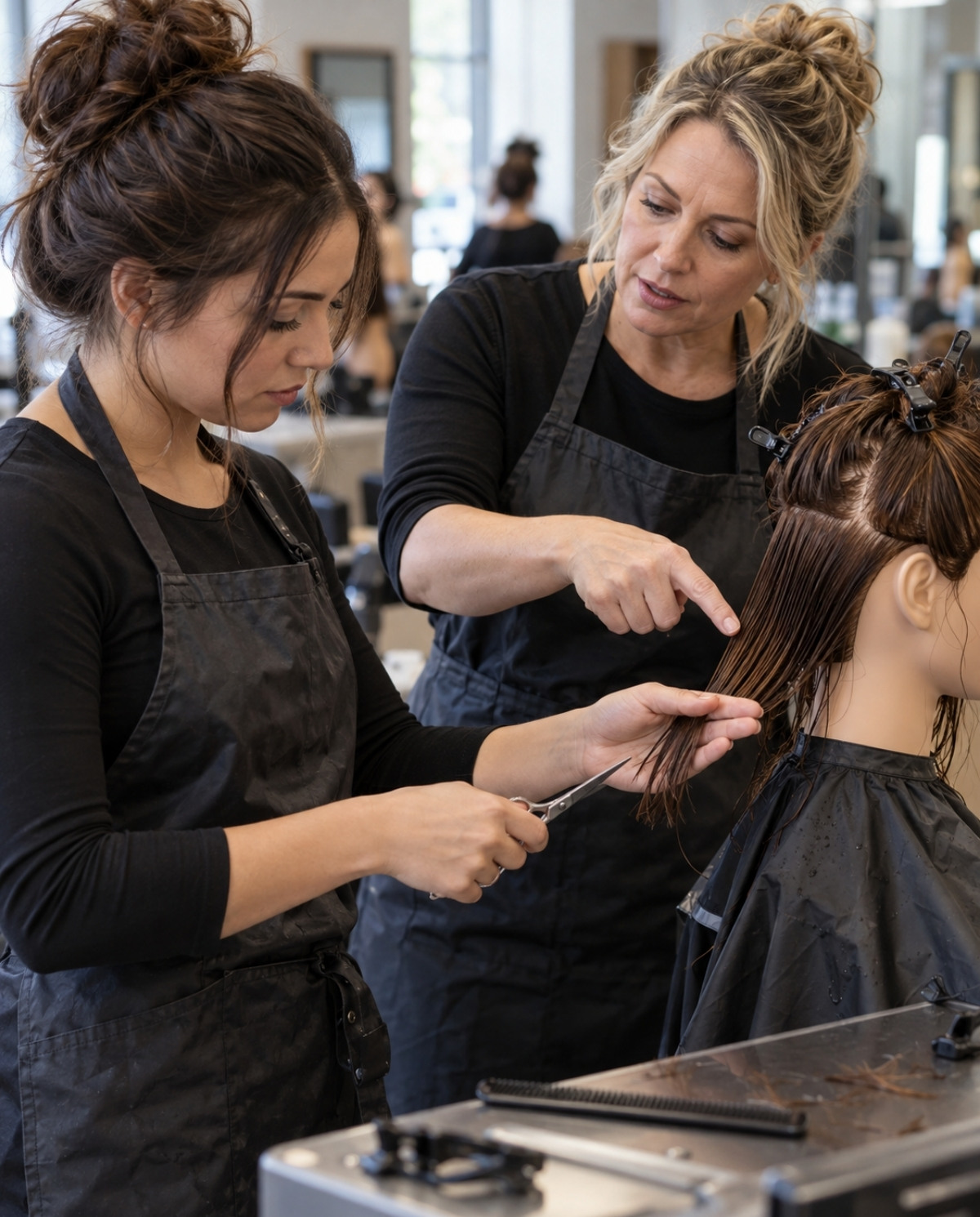
Instructor points to a section of damp mannequin hair while a cosmetology student holds the hair between her fingers and positions haircutting shears.

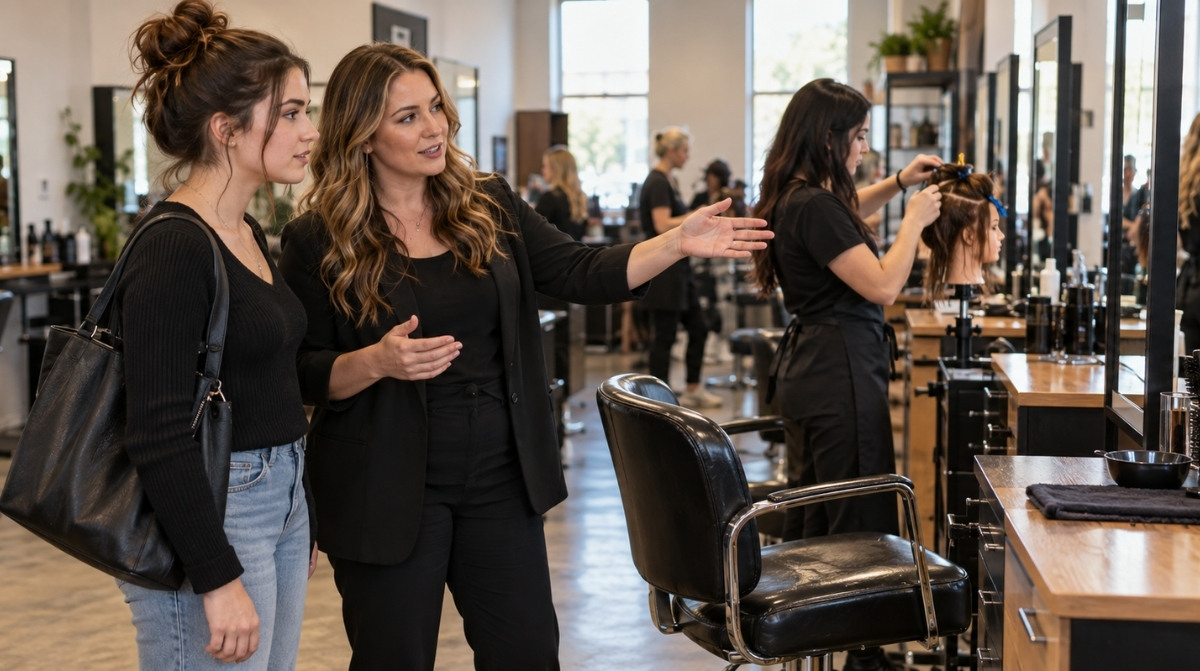
When visiting a student salon, look beyond the equipment and décor. Ask how appointments are assigned, when instructors check students’ work, and how practical assignments are evaluated.

Client requests may not arrive in the same proportions as curriculum requirements. Ask how the school arranges practice when a particular service is requested less frequently. You want to understand how students work through their training rather than assuming a busy appointment book answers that question.

If you are also considering a dedicated skincare program, compare the practical learning environment rather than assuming it mirrors a cosmetology salon. Our guide to what esthetician school is like offers a closer look at that training experience, helping you prepare more specific questions for a visit.

If observation is available, notice the teaching interactions. Does an instructor explain a correction? Can the student apply it and receive another assessment? Those exchanges help you evaluate the learning process.

Hogan’s salon menu includes cornrows, loc services, roller sets, rod sets, and finger waves. These offerings give you specific techniques to discuss during a visit. Ask how related practice and assessment are organized, since a service menu alone does not establish how often each student performs them.

Notable Georgia Cosmetology Schools and Their Standout Features

Beaver Beauty Academy, Hogan Institute, Georgia Career Institute, and Health and Style Institute illustrate different educational features worth examining. This shortlist draws on published materials, including historical program descriptions, rather than a scored ranking or confirmation of enrollment availability.

Beaver Beauty Academy — Day and Evening Scheduling

Beaver Beauty Academy’s published admissions information describes a 1,500-hour Master Cosmetologist program with day and evening arrangements. Its evening schedule includes Saturday attendance, an important detail for someone hoping to preserve weekday working hours.

The school also publishes estimated completion periods and contract overage rates. These details allow students to examine how attendance and enrollment terms interact, rather than comparing tuition without considering what happens if training takes longer than expected.

Hogan Institute of Cosmetology and Esthetics — Schedule Variety and a Lilburn Location

Hogan’s published information provides several concrete points for students comparing cosmetology schools in Lilburn and the surrounding Atlanta area. Its 1,500-hour Master Cosmetologist program is accompanied by full-time, three-day, part-time morning, and part-time evening schedule options. Its financial information also separates tuition from registration, learning materials, uniforms, and kit charges.

That combination gives you a practical starting point: discuss an attendance arrangement, then request the financial terms that apply to your intended start date. Review current enrollment documents rather than relying on an older downloadable fee sheet.

The salon services described earlier provide another point of discussion, particularly if you want to explore different styling and textured-hair techniques. During a campus visit, connect those offerings with questions about assignments, instructor feedback, and additional practice.

For someone whose commute centers on Lilburn or nearby communities, Hogan brings location, schedule choices, and published program details into the same conversation. Your decision can then focus on the training arrangement and financial commitment that apply to you.

Georgia Career Institute — Digital Resources and Client-Building Practice

Georgia Career Institute’s published cosmetology materials describe Pivot Point’s LAB platform for theory assignments, program tasks, and assessments. The listed kit includes digital resources, electrical tools, practice mannequins, and supplies for several service areas. These details identify the learning resources described for the program more clearly than a general reference to modern technology.

The same materials describe a senior phase involving client services and opportunities to begin developing a client book. A client book refers to the relationships and service information supporting repeat appointments. That emphasis connects technical practice with maintaining professional client relationships.

Health and Style Institute — A Broader Salon Leadership Focus

Health and Style Institute’s published program descriptions described a Salon and Spa Leadership program combining preparation for master cosmetology licensure with additional skincare, makeup, and business education. That broader leadership emphasis was a distinguishing feature of its educational approach.

For someone interested in eventual management or ownership, this provides a useful comparison point: how much attention does a program give to the responsibilities surrounding a service business? Leadership coursework should still be evaluated separately from claims about employment, management readiness, or earnings.

Choose a Schedule and Commute You Can Sustain

For students comparing cosmetology schools near Atlanta, the practical commute is the journey at class time. Test the route when you would normally arrive and leave, including parking, transportation connections, and childcare arrangements where relevant.

Review instructional hours separately from campus business hours and salon service hours. Ask how breaks, holidays, absences, and makeup opportunities affect your progress.

Consider the tradeoff between weekly intensity and calendar length. Fewer instructional hours per week spread the required training over a longer period. A concentrated schedule may require larger changes to your working week.

Hogan’s published schedule choices give you several arrangements to discuss. Confirm which applies to your program and anticipated start date, and ask how a later schedule change would affect your completion plan.

Calculate the Full Cost Before Comparing Prices

Woman writes in a weekly planner at a kitchen table beside a smartphone displaying a route map, car keys, and a work bag.

Separate Tuition From Other School Charges

Request an itemized breakdown of tuition, registration, books, digital resources, uniforms, equipment, and required supplies. Ask whether examination and licensing expenses are included or paid separately.

For the kit, request an inventory. Clarify ownership, replacement responsibilities, and how consumable supplies are handled. “Kit included” becomes useful information only when you understand what is supplied and what you may need later.

Read withdrawal and refund terms before signing. The Federal Student Aid Handbook’s consumer-information guidance identifies charges, required materials, and withdrawal and refund policies among the disclosures participating institutions must provide.

Georgia’s equipment rules specify basic cosmetology kit contents, but they do not establish whether a school bundles those items into tuition. Confirm the equipment inventory and written charges separately.

Add the Expenses of Attending

Your personal budget should also account for transportation, childcare where applicable, and living expenses during training.

The federal financial-aid term cost of attendance describes an estimated educational budget that can include expenses beyond the school’s bill. Inclusion in that budget does not mean an expense will be fully funded.

Separate grants and scholarships from loans when reviewing funding. Ask what you would pay during training and what borrowing would need to be repaid afterward. This gives you a clearer picture than a monthly payment figure alone.

Ask What Happens Between Graduation and Your First Job

Completing school, passing examinations, and receiving a license are separate milestones. Georgia’s licensing guide lists passed written and practical examinations among the application requirements. Passing those examinations does not, by itself, mean your license has been issued; confirm that your license is active before beginning work as a licensed professional.

Ask what state board preparation includes. Look for explanations of practice assessments, help identifying weak areas, examination procedures, and document preparation. Find out whom you can contact if you need another attempt.

Evaluate career support just as specifically. If résumé assistance, interview preparation, or employer introductions are offered, ask how students access them. Each service is different from a guaranteed job.

Graduation, examination passage, and placement rates measure different results. The Federal Student Aid Handbook explains a federal graduation-rate framework focused on first-time, full-time students seeking a certificate or degree. Ask which students and reporting periods each percentage covers before comparing schools.

According to the Bureau of Labor Statistics, the occupation includes substantial self-employment, but its occupational wage figures exclude self-employed workers. Those wages cannot predict salon-owner income or an individual graduate’s earnings. If independent work interests you, ask about client retention, appointment management, and business responsibilities alongside technical instruction.

Bring These Questions to a Hogan Campus Visit
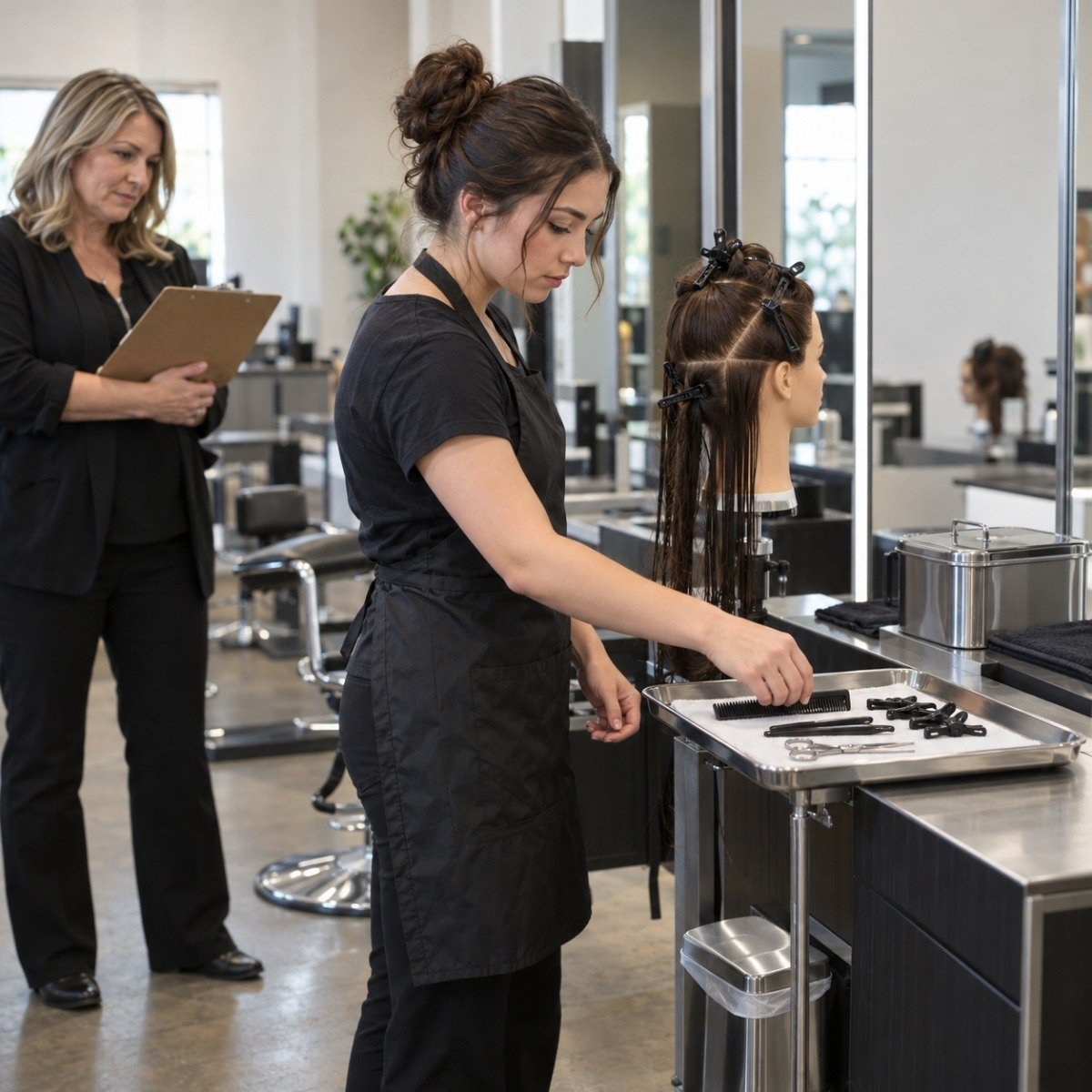
Cosmetology student arranges a comb, clips, and shears on a tray beside a sectioned mannequin while an instructor observes with a clipboard.

Bring your working hours, transportation arrangements, budget, and career interests into the conversation. Those details help turn general program information into a plan you can evaluate.

Ask how your weekly schedule would work, how readiness for client services is assessed, and what happens when you need additional practice. Request current written charges and discuss examination and licensing support.

You should leave understanding what the program requires, how your progress will be assessed, and whether the commitment fits your life. If something remains unclear, request clarification before signing an agreement.

Frequently Asked Questions

Do I Need Hair or Makeup Experience Before Applying to Cosmetology School?

Prior salon experience is not listed in Hogan’s published admission requirements. Those requirements address age, identification, and educational documentation. Ask admissions to confirm what applies to your circumstances.

Can I Visit a Cosmetology School Before Submitting an Application?

Visit arrangements vary. Hogan offers a no-obligation campus tour where prospective students can explore training spaces and discuss programs, schedules, and financial aid. Bring questions you want answered before applying.

Can Previous Cosmetology Training Count Toward a New Program?

Request a written evaluation before assuming previous hours will transfer. Confirm the receiving school’s acceptance policy, remaining training, resulting charges, and any applicable Board requirements. Federal disclosure guidance requires participating institutions to make their transfer-credit policies available.

Can a Georgia Cosmetology License Be Used in Another State?

The destination state determines eligibility through its licensing process. As the Bureau of Labor Statistics explains, requirements vary by state. Contact that state’s licensing authority before planning to practice there; holding a Georgia license does not automatically authorize work nationwide.

What Is the Difference Between Master Cosmetology and Hair Design?

Georgia establishes separate curricula: master cosmetology includes hair, skin, and nail training, while hair design follows a more hair-focused curriculum. The school pathways require 1,500 hours for master cosmetology and 1,350 hours for hair design. If your main goal is skincare, review the training and examination steps for an esthetician license as a separate educational pathway. Match your intended services to the appropriate license before comparing schools.

Ready to Master Your Craft?

Your future in beauty starts with skills you can build on. At Hogan Institute, our Salon Ready approach connects hands-on training with client service and professional habits to help you prepare for opportunities in beauty and work toward your long-term goals.

Come see our experience in action. Explore our Lilburn campus, meet our team, and discover the training environment behind your next step.

Complete the contact form below to discuss your goals, explore schedules, and become part of Hogan’s continuing story of beauty education.
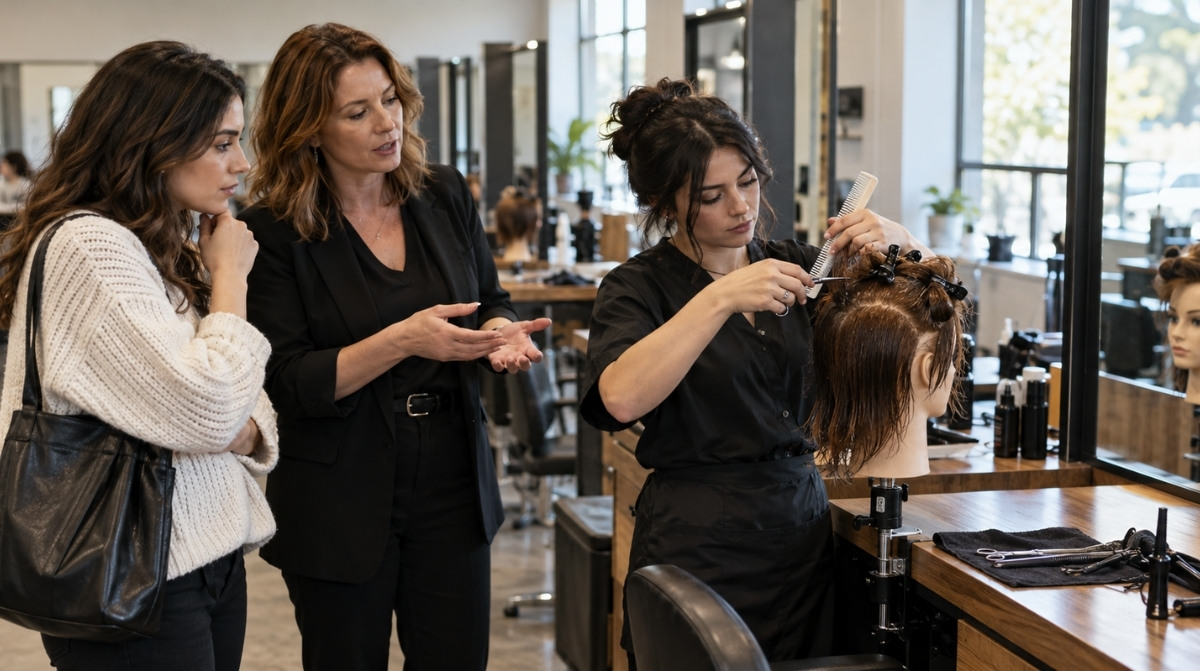

How to Choose a Beauty School in Georgia: Programs, Location, and Student Support

Key Takeaways

  • Choose a program that matches the services you want to perform.
  • Check state approval, accreditation, and financial aid eligibility separately.
  • Compare total costs and a schedule you can maintain.
  • Request an individual review before assuming previous training hours or a license will transfer.

Choosing a beauty school means finding training that fits your career goals, budget, and daily responsibilities. Whether you are exploring beauty training for the first time or reconsidering your original school choice, compare programs, credentials, schedules, total costs, and student support. Use this guide to evaluate your options and explore whether Hogan Institute of Cosmetology and Esthetics in Lilburn fits your next step.

Start With the Beauty Career You Want

When deciding between cosmetology and esthetician school, think about an ordinary workday rather than a career highlight reel. Would you enjoy consultations followed by cutting, coloring, and styling hair? Or would you prefer evaluating a client’s skincare needs and performing services such as facials and waxing? If you are still deciding whether this career fits you, our guide to the work, income considerations, and training behind a cosmetology career helps you look beyond the services you enjoy and consider the responsibilities of professional beauty work.

Cosmetology offers a broader training direction. Hogan’s Master Cosmetology program describes instruction in hair, skin, and nail services, along with client service and salon business. The BLS description of skincare specialists identifies work such as facials, hair removal, skincare advice, and client consultation—a more focused direction if skincare is your main interest.

Ask how practice is organized, not simply whether a technique appears on the curriculum. Watching a demonstration, practicing on a mannequin, and performing a service under supervision provide different learning experiences. Find out how students move between those stages and receive corrections.

You should also understand your scope of practice: the services your license legally permits you to perform. A national career description may mention treatments that require different credentials or conditions in Georgia. Ask how your intended program connects to the Georgia cosmetology licensure pathway—the training, examination, and application steps toward becoming licensed.

Career demand provides context, but it should not choose the program for you. According to the U.S. Bureau of Labor Statistics, skincare specialist employment is projected to grow 9% from 2025 to 2035. The agency’s approximately 14,200 annual openings include replacement hiring; net employment growth is approximately 9,100 jobs across the entire decade. Those are national projections, not promises of local jobs or individual outcomes.

Check State Approval, Accreditation, and Financial Aid Participation Separately

If you are looking for accredited beauty schools in Georgia, separate three questions that often get blended together: Can the school legally operate? Who reviews its educational standards? Can eligible students receive federal aid there?

Georgia’s school requirements require a license to operate a cosmetology or related beauty school. Accreditation involves review by an accrediting organization. The Federal Student Aid Handbook explains that participation in Title IV—the federal student aid system—requires Department of Education approval and additional eligibility requirements. These checks serve different purposes.

When comparing state-approved beauty schools in Georgia, request the current school license. Then ask for the accreditor’s name and verification information. Finally, confirm whether your intended program qualifies for the funding being discussed.

Hogan’s published financial aid information describes the institution as accredited and lists federal aid participation. Ask admissions to walk you through current documentation and explain what applies to your program. A written record is more useful than trying to remember everything discussed during a tour.

The same federal guidance makes an important distinction: institutional eligibility and approval to participate in aid programs are separate steps. An accreditation badge alone does not answer every financial aid question. That is why we should verify the school, the program, and your individual eligibility rather than assuming one credential covers all three.

Georgia and Arkansas: Match Your Training to Where You Plan to Work

An admissions adviser points to a document while a prospective beauty student reviews paperwork across a light wood desk.

Georgia’s cosmetology curriculum rule specifies at least 1,500 training hours over a minimum nine-month course. Its esthetics curriculum rule specifies at least 1,000 hours over a minimum nine-month course. These are curriculum minimums, not a promise that every student will finish in nine months.

Georgia also requires 250 hours of initial theory training before students advance to client services, with the progression requirements stated in each program’s rule. When we assess hands-on training, the useful question is how the school prepares students for that transition—not how quickly a beginner can start working on clients.

If you are considering Arkansas training or expect to move between Arkansas and Georgia, check the destination state’s requirements before committing. The Arkansas Department of Health’s cosmetology law describes an application process for professionals licensed in another state. Georgia likewise has licensing-by-endorsement rules. Endorsement or reciprocity means a route to apply using an existing license; it does not make a license automatically valid across state lines.

Transferring while still a student is a separate question from applying for a second state license after graduation. Ask the receiving school about accepted training hours and the destination licensing authority about professional eligibility. For Hogan’s Lilburn programs, Georgia’s requirements are the immediate reference point.

Choose a Location and Schedule You Can Attend Consistently

For students researching beauty schools near Atlanta, distance on a map can be misleading. Test the journey at your proposed arrival and departure times. A manageable midday drive may become a difficult commute when it overlaps with work or school traffic.

Hogan’s contact information lists its campus at 495 Indian Trail Lilburn Road NW, Lilburn, Georgia 30047. If you are comparing schools in Lilburn, calculate the trip from both home and work, and consider what happens when your usual transportation is unavailable.

If evening classes are essential, ask for the actual student timetable. Confirm the days, weekly training hours, scheduled breaks, and expected completion date. Published salon hours or office hours do not establish when students attend classes. Our explanation of how full-time and part-time attendance affect your training timeline shows how to estimate instructional weeks and account for breaks and missed hours before choosing a schedule.

Then discuss missed hours. Ask how makeup training is scheduled, whether it fits around work, and what happens if attendance problems continue. A useful attendance plan includes a backup for predictable disruptions, such as childcare changes, rather than relying on everything going perfectly.

Compare the Complete Cost, Not Just Tuition

When comparing beauty school tuition and fees, request a breakdown that distinguishes required charges, optional purchases, and costs paid to outside organizations. This helps you see both the overall expense and when money will be needed.

Ask whether tuition includes your kit, books, and initial supplies. Find out whether you must replace consumables during training, pay examination or licensing expenses separately, or cover additional charges if completion takes longer than expected. These are questions to investigate, not assumptions that every school imposes the same fees.

Your personal budget also matters. Transportation and childcare can make two similar tuition figures very different in practice. Compare costs over the expected program length, then ask how an extended completion timeline could affect them.

For schools offering financial aid, request an explanation that separates grants, loans, and payment arrangements. Federal Student Aid explains that grants generally do not require repayment, although certain circumstances can create repayment obligations. Loans carry repayment terms. A payment arrangement changes when you pay; it does not automatically reduce the amount owed. To explore how different funding sources might fit together, read our guide to FAFSA, grants, and other ways to pay for cosmetology school, including questions to ask before using a 529 education savings plan.

Hogan’s published financial aid information lists Pell Grants and several federal loan options for eligible students, along with payment arrangements and discussion of loan repayment. Ask for an individualized explanation of anticipated aid and the remaining balance you would be responsible for.

The Federal Student Aid Handbook’s payment-period guidance explains another detail many students miss. Clock hours measure training time, and later federal aid payments depend on successfully completing both required hours and instructional weeks in the preceding payment period. Repeated coursework can delay a disbursement. Ask how the school explains these milestones and communicates changes to your payment schedule.

Look for Student Support You Can Describe in Specific Terms

A prospective beauty student uses a calculator and notebook beside printed documents and an open pouch of hair training tools.

A school’s support becomes easier to evaluate when you ask about a specific problem. Instead of “Are your instructors helpful?” try: “If I keep struggling with a color formulation, how do I receive feedback and additional practice?”

The answer should tell you who helps, how progress is checked, and what happens next. Ask similar questions about theory lessons, practical assessments, attendance concerns, and licensing preparation. You are looking for a process you can understand.

Hogan’s Master Cosmetology page lists hands-on experiences, salon business, client retention, résumé writing, and job-seeking skills. Ask how these topics appear in assignments and practical work. Client retention, for example, becomes more useful when students practice consultations, explain home care, and respond professionally to concerns.

Business preparation deserves attention: BLS reports that approximately 48% of hairdressers, hairstylists, and cosmetologists were self-employed in 2025. However, BLS wage estimates exclude self-employed workers, so those figures cannot establish typical salon-owner earnings. Ask about preparation for managing appointments, communicating prices, and maintaining client relationships without treating entrepreneurship as guaranteed income.

If you began by searching for the best beauty schools in Georgia, turn that broad question into something testable: Which school offers the training and support that address your needs? When a school shares graduation, licensing, or employment outcomes, ask for the reporting period, who is counted, and how the result was calculated.

What to Look for When Comparing Beauty School Alternatives

If you started your research with Beaver Beauty Academy, Georgia Career Institute (GCI), or Health and Style Institute, you may already have a particular program or training experience in mind. When exploring alternatives, compare what you would actually learn, how you would practice, and whether the attendance commitment fits your responsibilities.

At Hogan Institute of Cosmetology and Esthetics, the published Master Cosmetology program combines hair, skin, and nail instruction with salon business, client retention, résumé writing, and job-seeking skills. That combination gives you specific things to evaluate: preparation for performing services, communicating with clients, and pursuing work after licensure.

During a campus visit, ask to see how those skills are taught. Discuss supervised practice, instructor feedback, and your proposed schedule so you can connect the program description to the experience you would have as a student.

Frequently Asked Questions

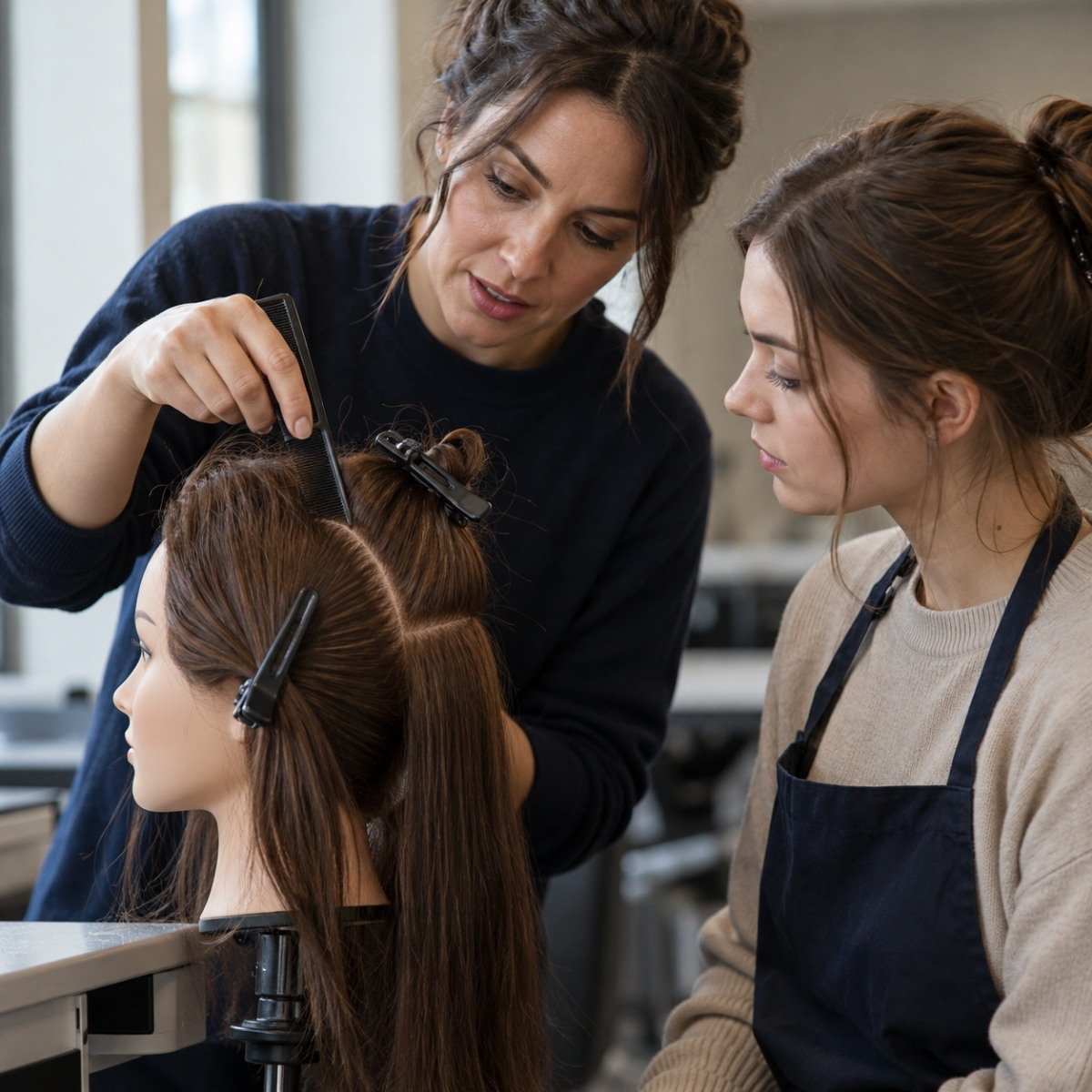
A beauty instructor uses a comb to explain a mannequin’s hair parting while a student watches closely at a practice workstation.

Can I tour a beauty school before applying?

Hogan’s tour information offers a free, 30-minute, no-obligation campus visit. Arrange it ahead of time and mention the program you want to explore. Ask whether your appointment can include discussion of training, scheduling, and financial planning.

Do I need previous beauty experience to enroll?

Hogan’s cosmetology page describes training that guides beginners toward professional preparation. Previous experience is separate from admission eligibility, so ask for current entry requirements and required documents. You do not need to arrive already knowing how to perform the services you want to learn.

What should I bring to a beauty school admissions appointment?

Bring a realistic availability plan, your questions, and any documents admissions requests. If you previously attended a beauty school, ask which official records are needed for evaluation. Write down financial questions in advance so you can discuss them without feeling rushed.

Can someone changing careers apply to beauty school?

Discuss your eligibility and intended program with admissions, then consider how training fits around your current employment. Existing experience in customer service, sales, or organization may be useful, but it does not replace the technical training and licensing requirements for your chosen profession.

Does living outside Lilburn prevent me from attending Hogan?

Confirm any applicable admission requirements directly. For daily planning, assess whether you can reliably reach campus during your proposed class hours. Include a transportation backup and account for work and family commitments when deciding whether the journey is sustainable.

Ready to Master Your Craft?

Your future in beauty starts with skills you can put to work. At Hogan Institute of Cosmetology and Esthetics, our Salon Ready approach combines hands-on training with client service, salon business, résumé writing, and job-seeking skills—helping you prepare for opportunities in salons and explore future entrepreneurship.

Join a community where your creativity has room to grow. Complete the contact form below to arrange a campus visit, see our training in action, and discover how you can become part of Hogan’s next chapter.

Mortuary Cosmetology Behind the Scenes: Products, Preparation, and Professional Boundaries

Essential Points Before Entering Mortuary Beauty Work

  • State Rules Define Your Role: A background in beauty services provides useful skills for hairstyling, makeup, and nail care. However, a beauty license does not automatically authorize every task performed in a funeral home. Consult both your state beauty board and funeral-service regulator about the services you intend to offer.
  • Education and Apprenticeship Follow Different Routes: Georgia and Arkansas require 1,500 hours for their school-based cosmetology pathways. Georgia also recognizes a cosmetology apprenticeship requiring 3,000 hours and a minimum of 18 months.
  • Working Arrangements Differ: Some professionals provide cosmetic care as funeral-home employees, while others accept freelance or on-call assignments. Discuss expected case volume, responsibilities, and payment terms directly with prospective establishments.
  • Coverage Should Suit the Individual: Mortuary cosmetic products offer translucent and opaque options. Skin condition, discoloration, and the requested appearance guide product selection; heavy coverage is not necessary for every case.
  • Professional Connections Provide Useful Insight: Conversations with local funeral directors can reveal service needs, credential expectations, supervision requirements, and preparation-room procedures.

Some stylists eventually want to use their abilities in a setting that offers a different kind of personal meaning. Desairology—the cosmetic care of deceased individuals—can provide that opportunity. By helping recreate a recognizable appearance, professionals in this field can contribute to the way families remember and say goodbye to someone they love.

The work also introduces responsibilities beyond a typical salon appointment. Understanding applicable regulations, preparation-room hazards, specialized products, and local working arrangements gives you a more realistic starting point.

The Purpose and Daily Tasks of Mortuary Cosmetic Care

Mortuary beauty work centers on a respectful presentation that reflects the individual and the wishes surrounding their funeral. A dramatic transformation is usually not the objective. Instead, the requested result may be a familiar hairstyle, subtle cosmetic correction, or details associated with the person’s everyday appearance.

The services you perform depend on your authorized role, the condition of the remains, and the funeral establishment’s instructions. They may include:

  • Hair and Facial-Hair Services: Cutting, arranging, or styling hair, with beard grooming or other facial-hair services where permitted.
  • Makeup Application: Selecting suitable shades, correcting visible discoloration, and applying foundation, lip color, or other cosmetics to achieve the requested presentation.
  • Nail Services: Cleaning, shaping, or polishing nails when requested and allowed within your responsibilities.

Photographs help establish a visual reference, but they cannot answer every question about personal preferences. Someone who usually avoided cosmetics may require a different finish from someone recognized for a distinctive lipstick or carefully styled hair. Ask the funeral director which image should guide your work and whether any religious, cultural, or personal considerations affect the requested services.

This specialty belongs among the broader cosmetology career opportunities that beauty professionals may explore. Entering a specialized setting requires more than transferring salon techniques; additional instruction, safety preparation, and any applicable authorization remain important.

Checking the Credentials Your Intended Services Require

A four-year mortuary science degree is not something you should assume is necessary for every hair or makeup assignment. Equally, holding a cosmetology license does not establish permission to undertake every form of post-mortem preparation.

The answer depends on the jurisdiction and the specific activities involved. For example, Florida’s Department of Business and Professional Regulation states that makeup and hair arranging on deceased people in funeral homes are not regulated by that department. It directs inquiries to the Division of Funeral, Cemetery & Consumer Services for further clarification. That statement addresses the named services and does not authorize unrelated preparation tasks.

Before paying for a course, describe your proposed services to both the beauty board and the funeral-service regulator in your state. Ask which individual credentials, supervision arrangements, and establishment requirements apply, along with any activities restricted to authorized funeral-service personnel. A written response can help you document the guidance you receive.

Developing Skills Through a Beauty Program

For someone pursuing cosmetology education, an approved program can introduce practical techniques in hair, skin, and nail care alongside color theory and sanitation.

Georgia’s school curriculum specifies 1,500 training hours with a minimum duration of nine months. Arkansas likewise identifies a 1,500-hour requirement for cosmetologist training. A separate option in Georgia is the cosmetology apprenticeship, which requires 3,000 hours and at least 18 months.

These requirements concern general cosmetology education and licensing, rather than a distinct mortuary-cosmetology credential. Our state-by-state cosmetology license guide provides additional background for questions you can bring to the relevant board.

When researching schools, check whether the licensing board accepts the specific program you plan to complete. Accreditation and state approval serve different purposes, so one should not be treated as a substitute for the other.

Recognizing Tasks Outside Your Authorized Role

Cosmetic application and embalming involve different responsibilities. A cosmetology or barbering credential alone does not authorize embalming. Likewise, a procedure does not automatically fall within a beauty professional’s scope simply because the work occurs on the body’s exterior.

  • Beauty Professionals: Cosmetologists and barbers may contribute services permitted under the applicable rules and establishment policies. Their licenses have different scopes, so neither credential should be assumed to cover every hair, makeup, skin, or nail task.
  • Embalming Professionals: Licensing requirements are established by the relevant state. Depending on the jurisdiction and licensing route, these may involve approved funeral-service education, supervised practical experience, and examinations.
  • Additional Training Providers: Private courses may offer instruction in mortuary products, presentation, or workplace practices. Completing a course does not replace a license or authorization required for the work itself.

For Georgia applicants, the Board of Funeral Service’s personal licensure rules require graduation from an ABFSE-accredited funeral-service college or another college specifically approved by the Board. Applicants must also document 3,120 apprenticeship hours and assistance with embalming at least 50 bodies. For licensure by examination, the rules identify the Funeral Service Science Examination of the National Conference of Funeral Service Examining Boards.

The American Board of Funeral Service Education’s directory helps readers locate accredited funeral-service programs. FINE Mortuary College’s resource collection also discusses licensing pathways, although current requirements should be confirmed with the board responsible for your intended license.

When a case involves reconstruction, invasive treatment, or another activity outside your competence or authorization, refer it to the establishment’s appropriately qualified professional. Artistic ability and beauty education do not independently grant permission to perform those procedures.

Selecting Makeup for Post-Mortem Presentation

Mortuary cosmetic application begins with evaluating the individual case. Skin condition, texture, discoloration, and the requested finish help determine the appropriate level of correction.

Post-mortem skin should not universally be described as non-porous, and liquid cosmetics should not be dismissed as unusable. Specialized products differ in formulation and coverage. A heavier application is not automatically a better one.

The instructions for Dodge’s Aquachrome cosmetics, for instance, describe a water-based, translucent product for normal skin. The manufacturer explains that translucent cosmetics preserve visible natural skin tone and are not intended to conceal discoloration. The instructions also label the product for professional embalming use, reinforcing the importance of following product directions and the establishment’s authorized practices.

Consider these principles when learning how to choose and apply specialized cosmetics:

  1. Match Coverage to Correction Needs: A translucent product may suit skin that needs little concealment. An opaque option may be appropriate where discoloration requires greater coverage. Let the case determine the choice.
  2. Learn Each Product’s Intended Use: Formulas differ in consistency, finish, and application requirements. Read the manufacturer’s directions and obtain supervised instruction before using unfamiliar products. Airbrushing may be useful in some circumstances, but it is not essential for every assignment.
  3. Separate Makeup from Reconstruction: Concealing a color difference and rebuilding a facial feature are different activities. Cosmetic application skills do not establish the training or authorization needed for structural restoration.
  4. Review the Result in Viewing Light: Where practical, assess the finished appearance under the lighting used for the viewing. Compare the result with the chosen reference image and requested presentation rather than relying on a standard color adjustment for every location.

The Career Trend article on entering mortuary makeup work discusses specialized product knowledge and sanitation training. For decisions about a particular product or procedure, manufacturer guidance and supervised professional instruction provide more specific direction than a general career article.

Color knowledge remains useful, but careful restraint matters as well. The objective is to use the amount of correction needed to achieve the requested appearance.

Preparing for Hazards in the Funeral-Home Workplace

A calm atmosphere does not mean a preparation room is free of occupational hazards. Assigned duties may involve contact with blood or other potentially infectious materials, contaminated tools, or chemicals used during preparation.

OSHA’s funeral-home guidance on bloodborne pathogens addresses requirements associated with reasonably anticipated occupational exposure. Its separate guidance on formaldehyde exposure in funeral homes explains the application of the formaldehyde standard to exposure associated with embalming.

Before agreeing to work in the facility, review the following subjects with the establishment:

  • Required Instruction: Identify the hazards connected to your duties and the training needed before you begin.
  • Personal Protection: Establish which protective equipment is appropriate and who will provide it.
  • Chemical Handling: Locate safety data sheets and learn the relevant ventilation, storage, and handling procedures.
  • Decontamination and Disposal: Understand how tools, work surfaces, disposable supplies, and contaminated materials must be managed.
  • Incident Procedures: Know whom to notify and what actions to take following an exposure, splash, or injury.

Applicable obligations depend on both the working arrangement and the exposure circumstances. Reviewing the facility’s procedures before entering the preparation room helps you prepare for requirements that may differ from routine salon sanitation.

Evaluating Earnings and Contract Terms

The financial side of this specialty deserves the same attention as its personal meaning. Staff positions and independent assignments are both possible, but the available workload and payment structure depend on the establishment.

The Indeed overview of becoming a mortuary cosmetologist discusses employment and independent-contracting options. These arrangements should be evaluated separately because an annual salary estimate does not establish an appropriate fee for a freelance case.

As of October 5, 2026, ZipRecruiter’s Mortuary Cosmetologist category displayed an estimated national average of $43,287 annually, or approximately $20.81 per hour. Its separate Mortuary Cosmetology category displayed $45,943 annually, or approximately $22.09 per hour.

Those figures belong to separate job categories. They are general salary estimates and should not be combined into a standard hourly range or interpreted as confirmed entry-level wages, contractor prices, or promised earnings.

Before accepting an opportunity, clarify the payment arrangement:

  • Employee Positions: Ask about assigned duties, expected weekly hours, whether any hours are guaranteed, and how availability or work outside the usual schedule is handled.
  • Contract Assignments: Define the services included in the case fee, supply responsibilities, travel charges, urgent scheduling, and payment for additional requests.
  • Combined Funeral-Service Positions: Work involving embalming, funeral directing, or other preparation duties carries separate responsibilities and licensing requirements. Compensation for those positions is not a direct benchmark for hair and makeup services alone.

For independent work, the amount invoiced is gross business revenue. Travel, preparation, cleanup, products, administration, insurance, and applicable taxes all affect what remains after expenses.

Before depending on mortuary cosmetic work as your primary income, ask prospective establishments how often they need the services and who currently performs them. Maintaining salon work alongside this specialty may offer flexibility, but reliable earnings depend on local demand, case volume, and the agreements you establish.

Approaching Funeral Directors and Developing Experience

A conversation with a funeral director can reveal details that a job listing may leave unanswered. You can learn whether the establishment engages outside beauty professionals, which services it needs, and what preparation it expects from someone entering the setting.

Job boards remain useful, and professional outreach can complement them. There is no need to assume that opportunities follow a particular advertised-versus-unadvertised percentage.

To develop contacts and assess whether this work suits your goals:

  1. Define the Services You Want to Provide: Confirm applicable requirements before choosing a training route. General beauty education, funeral-service study, or additional supervised instruction may suit different intended roles.
  2. Prepare a Suitable Portfolio: Demonstrate natural makeup, accurate shade matching, subtle correction, and varied hairstyles using living models or mannequins. Photographs of deceased individuals should not be taken, shared, or included without appropriate authorization and compliance with applicable rules and establishment policies.
  3. Arrange a Professional Introduction: Request a brief meeting and explain your qualifications, proposed services, availability, and willingness to learn the establishment’s procedures.
  4. Discuss Practical Expectations: Ask who performs cosmetic preparation, whether contractors are engaged, what supervision is required, and how supplies, scheduling, and payment are organized.
  5. Seek Relevant Supervised Learning: Obtain instruction suited to your responsibilities before accepting unfamiliar cases. Observation or practical participation must be authorized by the establishment and remain within applicable limits.
  6. Show Dependability and Respect for Privacy: Follow agreed schedules, observe safety procedures, protect sensitive information, and disclose when a request exceeds your competence or legal scope.

Our guide to next steps after beauty school offers broader information about licensing, portfolios, and the transition into employment.

Professional trust grows through consistent performance and clear communication. Technical skill matters, but so does understanding family preferences, facility procedures, and the boundaries of your role.

Common Questions About Entering This Specialty

How can I assess my comfort with the emotional side of the work?

People respond differently to working around death and bereavement. Some find the role meaningful, while others find the environment difficult. Speak with experienced professionals and consider an authorized observation opportunity if one is available. Reflect on your boundaries, comfort with the setting, and the support you could use after a challenging case.

Which funeral-home services might suit a barber?

Haircuts, beard grooming, and shaving may be relevant, depending on the applicable regulations and establishment policies. Verify the requirements for each proposed service. A barbering credential should not be assumed to authorize all cosmetic, skin, or nail work.

What should I consider before purchasing a dedicated kit?

Separate supplies can help organize your work and support the facility’s contamination-control practices. First ask which products and tools the establishment supplies and which it expects you to bring. Airbrush equipment is not universally required, and unfamiliar products should be used only with appropriate instruction.

What does a private mortuary beauty certificate establish?

It records completion of the provider’s course. It does not replace a license, authorization, or employer requirement that applies to your services. Determine the legal requirements for your intended role before deciding whether a course provides useful additional preparation.

How can I calculate a fee for an individual assignment?

Define the requested work and estimate the full time involved, including travel, setup, and cleanup. Include relevant expenses and discuss local expectations with prospective funeral-home clients. Record the agreed services and payment terms in writing. National salary figures do not establish a standard freelance case fee.

Explore Your Next Step in Beauty Education

A thoughtful plan for mortuary cosmetic work combines practical beauty skills with knowledge of state requirements, workplace safety, and the limits of the intended role. Hair design, color theory, skin knowledge, and sanitation can provide a useful base for further specialized learning.

Hogan Institute’s Master Cosmetologist program offers training in hair, skin, and nail services. If you are considering a beauty education pathway, visit our Enrollment page to learn about admissions and request a campus tour.

Contact our admissions team through the website to discuss program options, scheduling, and the next steps toward your education goals.